Navigating National Radio Research Agency Technical Standards for Wireless Equipment
RRA compliance demands exact technical track matching, accredited RF and EMC testing, local representative holdings, and correct KC mark layout.
Topology
South Korea regulates RF equipment by risk tier under the Radio Waves Act, enforced by the National Radio Research Agency. The framework covers every commercial transceiver, intentional radiator, and high-frequency digital device entering the country, requiring importers and hardware designers to identify their compliance pathway before scheduling lab time.

Regulatory Classification under Article 58
Transmitters entering South Korea fall into three regulatory categories under state oversight. High-risk equipment ~ such as cellular base stations, satellite ground nodes, and marine navigation radars ~ requires Conformity Certification. This route demands rigorous evaluation in state-designated laboratories within South Korea or through recognized reciprocal treaty partners, culminating in a government-issued certificate.
Moderate and low-risk devices ~ including short-range Wi-Fi, Bluetooth, Zigbee, and sub-GHz hardware ~ follow the Conformity Registration track, which splits based on output power and spectrum use. High-power or wideband short-range gear requires testing at accredited designated labs, whereas low-power equipment under 10 mW can register using internal or third-party laboratory data.
Radio devices operating under 10 mW output power in the 2.4 GHz spectrum qualify for self-testing registration through designated test facilities.
Emerging technologies lacking established national standards go through Interim Conformity Assessment. This route offers conditional market entry while authorities draft permanent testing rules, with a technical committee evaluating safety, potential RF interference, and spectrum usage before issuing a time-limited approval.

Assessment Stream Selection Matrix
Choosing the right path determines whether an importer can submit laboratory reports directly or must wait for government approval. That choice sets review timelines, sample requirements, and future audit exposure.
| Device Category | Regulatory Track | Testing Location Requirement | RRA Review Window |
|---|---|---|---|
| High-Power Radio, Marine Radar, Base Stations | Conformity Certification | State-Designated Laboratory | 15 Business Days |
| Industrial Wi-Fi, Bluetooth, SRD (>10 mW) | Conformity Registration | Accredited Designated Laboratory | 5 Business Days |
| Low-Power SRD, RFID ( | Conformity Registration | Qualified Testing Facility | 5 Business Days |
| Emerging Wireless Gear without KS Standards | Interim Conformity Assessment | Specialized Technical Committee | 60 Business Days |
Misidentifying a device’s classification creates severe bottlenecks at customs. For instance, registering high-power short-range equipment under the low-power self-testing track can result in administrative holds, revoked certificates, and mandatory product recalls.
- Unlicensed Band Misclassification occurs when teams assume international 5.8 GHz ISM band limits align with South Korean allocations without verifying local band edges.
- Power Output Threshold Violations occur when conducted RF power exceeds 10 mW per MHz, moving a short-range device from self-registration into mandatory testing at a designated lab.
- Incomplete Test Parameter Scans stem from relying on generic commercial EMC profiles while overlooking specific RF exposure guidelines in RRA notices.
Picking the wrong administrative route can leave container shipments stranded at the Busan docks, accumulating daily demurrage fees while waiting for clearance.
Mask
Excessive spurious emissions are a frequent cause of failed transmitter applications. Technical criteria in National Radio Research Agency notices set strict limits on occupied bandwidth, carrier drift, and out-of-band energy density, requiring engineering teams to fine-tune firmware across both ISM and licensed bands.
Spurious Emission Limits and Spectral Boundaries
Transmitter measurements enforce clear attenuation boundaries outside assigned channels. Under KS X 3123 specifications for unlicensed 2.4 GHz short-range devices, spurious emission limits apply from 30 MHz to 26 GHz. Unwanted conducted and radiated emissions outside the operating band must stay below -36 dBm under 1 GHz and below -30 dBm above 1 GHz.
The radiated emission limit of -30 dBm between 1 GHz and 40 GHz assumes a 3-meter distance inside an anechoic chamber with an average detector and 1 MHz resolution bandwidth. Moving the antenna to 10 meters lowers the observed field strength threshold by about 10.5 dB, easily turning marginal passes into failures.
Radiated spurious emission peaks consistently emerge at the second harmonic of the fundamental clock frequency during maximum modulation bandwidth runs.
Suppressing harmonics requires careful circuit design. Second and third harmonics from power amplifier non-linearities must be filtered with LC low-pass or microstrip notch filters before reaching the antenna port. A single peak exceeding the -30 dBm limit halts registration until board tweaks or additional shielding reduce the noise floor.
Frequency Stability and Occupied Bandwidth Bounds
Carrier drift limits ensure proper operation across temperature extremes. Regulations set maximum frequency tolerances in parts per million (ppm) across chamber sweeps from -20°C to +50°C. Unlicensed 2.4 GHz transceivers must stay within ±20 ppm of nominal frequency, whereas 5 GHz infrastructure hardware is restricted to ±10 ppm.
Occupied bandwidth testing checks that 99 percent of total signal power falls within the designated channel mask. For 5 GHz WLAN systems under RRA technical notices, rules limit channel bandwidth and mandate Dynamic Frequency Selection (DFS). In the 5.25–5.35 GHz and 5.47–5.725 GHz bands, radios must detect weather and military radar signals down to -62 dBm, perform channel availability checks within 60 seconds, and vacate active channels within 200 milliseconds upon detecting radar.
Engineers continue to debate whether 6 GHz indoor low-power access points can reliably pass adjacent channel attenuation during thermal throttling without physical attenuation pads.
Immunity
Electromagnetic compatibility rules evaluate a system’s resilience to electrical interference. South Korea aligns its criteria with national KS C 9610 standards ~ replacing the older KN standards ~ to maintain consistency with CISPR and IEC frameworks. Testing evaluates both a device’s unwanted emissions and its resistance to external interference.
Can MRA Laboratory Reports Substitute Local Testing?
Bilateral trade agreements allow accredited foreign facilities to generate valid test documentation for certain product types. Under Phase 1 Mutual Recognition Agreements (MRAs), designated labs in the United States, Canada, and the European Union can perform radio and EMC testing for Conformity Registration. Reports from these facilities pass through RRA portals without needing duplicate chamber scans in Seoul.
However, Phase 1 agreements are not universal waivers. High-risk devices subject to Conformity Certification must still be tested in Phase 2 MRA laboratories or domestic Korean facilities. Furthermore, overseas test plans must apply South Korea’s specific technical limits rather than standard FCC Part 15 or ETSI EN 301 489 profiles.
Performing radiated emissions testing at ten meters in Phase 1 laboratories helps reduce shipping costs, provided test parameters are aligned early to prevent retesting delays.
The 3 V/m field strength requirement under KS C 9610-4-3 across the 80 MHz to 6 GHz range relies on annual unmodulated continuous-wave calibrations. However, applying 80 percent amplitude modulation at 1 kHz during active sweeps can saturate local receiver front-ends, altering immunity failure thresholds by up to 6 dB depending on trace geometry.
- Configure the transceiver for maximum RF output power using test firmware to force continuous modulation.
- Expose the host chassis to a continuous RF electromagnetic field from 80 MHz to 6 GHz at 3 V/m while tracking carrier drift.
- Apply electrostatic discharges up to ±4 kV contact and ±8 kV air discharge to exposed metal interfaces and seam gaps.
- Inject electrical fast transients at 1 kV peak voltage into power lines for two minutes per polarity setting.
- Confirm no loss of user data, no unintended transmissions, and automatic recovery of functional links after testing.
Adhering to KS C 9610-4-3 Clause 8.2 increases the minimum dwell time per frequency step from one second to three seconds, adding roughly four hours to each radiated scan cycle.

Modification
Hardware modifications often require re-testing. Integrators sometimes assume that using a pre-certified wireless module eliminates host-level filings, but RRA rules require host evaluation regardless of module status.
Scope Bounds for Modular Transmitters
Pre-certified radio sub-assemblies lower development costs, but they still come with host integration limits. Integrating an approved module waives standalone RF re-testing only if antenna gain, trace layout, and output power match the initial filing exactly. The finished host unit must still undergo full EMC testing under KS C 9610 and receive a host Conformity Registration before entering the market.
Maritime radar magnetrons and industrial microwave vessels operate under similar wave constraints, where waveguide dimensions force RF energy into precise geometric modes that act more like fluid moving through a pipe than free-space radiation.
Changing antennas requires mandatory re-scans, while co-located radios bring additional testing demands. For instance, running Wi-Fi and Bluetooth modules simultaneously within 20 centimeters of one another requires intermodulation scans to verify that combined spurious emissions remain within legal limits.
Article 58-2 of the Radio Waves Act invalidates an existing certificate when antenna gain increases by more than 2 dB without administrative update filings.
Permissive Change Thresholds and Retest Scenarios
Component changes require administrative updates based on their impact on the circuit. RRA notices categorize modifications into minor and major technical alterations. Minor changes require administrative notification within 30 days of implementation on the production line, whereas major changes require full physical re-testing and updated filings before revised units can ship.
For example, an industrial gateway manufacturer integrating pre-certified LTE and Wi-Fi modules into a host chassis faces two options. Pursuing full host certification requires complete RF chamber testing at roughly 5,500,000 KRW, host EMC testing at 3,800,000 KRW, and an RRA registration fee of 250,000 KRW ~ totaling 9,550,000 KRW over six weeks. Taking advantage of modular integration waives standalone RF testing, requiring only 3,800,000 KRW for host EMC testing and a 180,000 KRW registration fee, cutting costs to 3,980,000 KRW and shortening the timeline to two weeks.
- Antenna Type Alterations require complete radiated spurious scans and updated radiation pattern submissions even if antenna gain remains unchanged.
- Passive Component Swaps in matching networks require modification filings if trace impedance shifts by more than five ohms.
- Firmware Power Table Updates that increase conducted output power beyond approved limits trigger immediate revocation of the certification.
- Enclosure Material Changes, such as switching from plastic to metal shielding, require fresh radiated EMC testing under KS C 9610 standards.
Pin-compatible radio revisions are frequently treated as minor, yet customs inspections can easily halt shipments if an unannounced silicon stepping code change is detected.

Foil
Physical markings provide immediate proof of compliance for customs inspectors. Product enclosures, packaging, and manuals must display official compliance marks adhering strictly to formatting standards. Minor errors like incorrect font sizes, omitted registration codes, or missing manual warnings can cause customs holds at the port.
Syntax and Placement of Korea Certification Identifiers
The national standard mark combines an emblem logo with an alphanumeric registration string. The KC logo features a stylized graphic alongside an administrative identification code formatted according to specific rules.
The registration string follows a set structure: R-C-AAA-BBB. for Conformity Certification or R-R-AAA-BBB. for Conformity Registration.
The initial R denotes authority under the Radio Waves Act, while the second letter indicates the track (C for certification, R for registration). The AAA segment is the three-character Applicant Identification Code issued by the RRA, and the final BBB. portion is a product code of up to 14 alphanumeric characters chosen by the applicant.
Label placement is critical for customs clearance. Marks must be permanently affixed to the exterior of the device housing. For small hardware under 30 mm by 30 mm, the mark may be placed on secondary packaging and embedded within electronic display menus, provided the outer packaging displays the complete KC logo and registration string.
Local Korean certificate holders retain exclusive legal ownership of the approval grant regardless of who funded the underlying chamber testing.
In Country Legal Agent Obligations
Foreign manufacturers without a registered corporate entity in South Korea must appoint a local representative. Known as the Local Applicant, this entity assumes legal responsibility before the National Radio Research Agency. The representative holds the certificate grant, oversees regulatory audits, and incurs legal liability for non-compliance under South Korean law.
Local representatives hold the legal rights to the certificate, local agents assume administrative responsibility, and customs officials retain authority to hold non-compliant radio gear.
Designating a local distributor as the certificate holder introduces commercial risks. If the business relationship ends, the brand owner cannot transfer or modify existing approvals without a formal legal release signed by that distributor. Appointing an independent legal agent or setting up a local subsidiary preserves operational control across distribution channels.
- Applicant Code Registration assigns a permanent three-character prefix to the South Korean legal entity prior to filing.
- Housing Engraving Verification confirms that the KC logo maintains its required minimum height of four millimeters after protective coatings are applied.
- User Manual Warning Ingestion ensures compulsory Korean-language interference notices are included with every retail unit.
- Agent Authorization Filings establish formal power-of-attorney documentation connecting foreign manufacturers to their local representative.
Printing the radio identifier directly onto metallic enclosures avoids compliance issues if high humidity and thermal operating conditions cause adhesive labels to peel.
Timeline
Securing lab testing slots early is critical for staying on schedule. Conducting pre-scans can prevent costly full-chamber retests, while administrative filings, lab queues, and sample logistics create dependencies that require tight oversight throughout product development.

Sample Preparation and Firmware Configuration
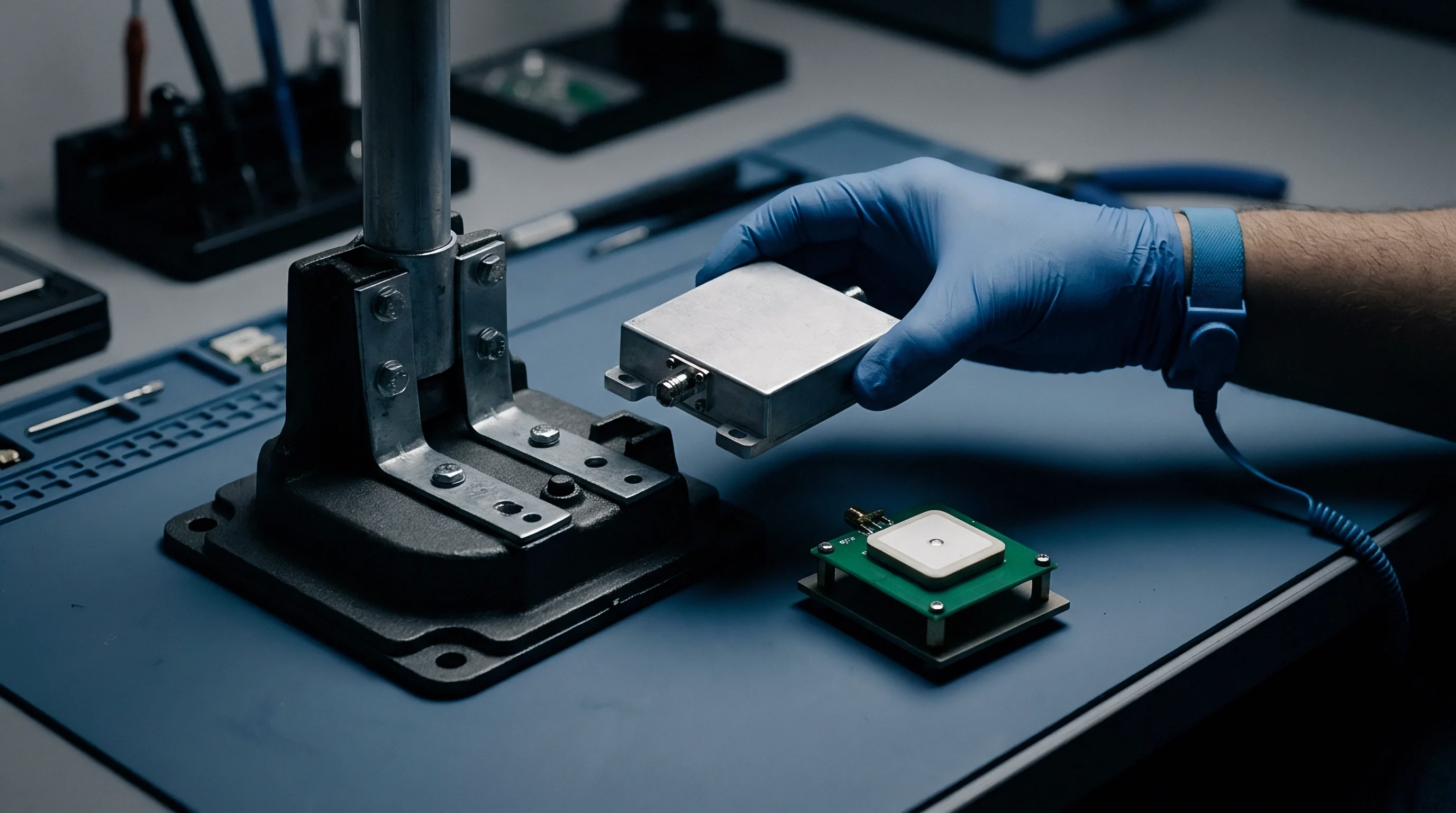
Engineers must prepare custom hardware units capable of operating in locked RF states. Labs require two dedicated conducted samples fitted with SMA connectors wired directly to antenna traces. These units run specialized test firmware to lock transmission on specific channels, turn off frequency hopping, select modulation formats, and control maximum output power via serial commands.
Well-configured test firmware speeds up testing, whereas unexpected failures and retesting can delay launch by several weeks. In addition to modified units, labs need one fully assembled radiated sample ~ complete with final enclosure, power supplies, and interface cabling ~ for EMC and radiated spurious testing.

Cost Allocations and Queue Dependencies
Budget calculations require accounting for lab fees, government duties, and legal representation retainers. Testing costs vary depending on frequency bands, modulation complexity, and EMC requirements.
Annual in-country agency fees among Korean law firms range between 1,200,000 KRW and 3,500,000 KRW. This variance stems from unstated retainers and local processing markups omitted from published fee schedules, making it prudent to lock in a multi-year fixed representation fee before turning over test samples.
| Filing Stage | Duration (Weeks) | Estimated Fee (KRW) | Primary Deliverable |
|---|---|---|---|
| Test Sample Setup and Firmware Verification | 1 – 2 | 500,000 – 1,000,000 | Functional RF control test bench |
| In-Country RF & EMC Chamber Scans | 2 – 3 | 4,500,000 – 8,500,000 | Accredited test report |
| Local Representative & File Preparation | 1 | 1,200,000 – 2,500,000 | Formal application dossier |
| RRA Governmental Assessment Review | 1 – 3 | 180,000 – 350,000 | KC Conformity Certificate or Registration |
| Post-Grant Label Verification & Archiving | 1 | 300,000 – 600,000 | Verified packaging compliance file |
Settling pre-scan lab fees early guarantees chamber time before the year-end compliance rush overwhelms schedules at facilities across Seoul.