Wireless Module Selection Criteria for Emerging Market Approval
Verify unredacted ISO 17025 test dossiers, local band compatibility, and vendor test-firmware support before purchase to avoid border seizures.

Gate
A wireless module vendor hands an OEM customer an FCC Grant of Equipment Authorization alongside a CE Declaration of Conformity. The customer assumes these two files guarantee swift entry into Brazil, India, Indonesia, and South Africa. That assumption collapses at the border.
Mature Western regulatory regimes rely on supplier declarations, third-party accredited test summaries, and modular approval grants where the host product inherits compliance by integrating the radio under established conditions. Emerging market national regulatory agencies (NRAs) operate under an entirely different posture, using radio type approval as an instrument of industrial protection, spectrum sovereignty, and import tariff collection.
Modular approval rules vary wildly by territory. The FCC allows a full modular grant to cover the radio circuit within any host product, provided antenna gain stays below the maximum listed on the grant and trace routing matches the integration manual. Emerging market agencies frequently reject the concept altogether.
Regulators in Brazil, Indonesia, and Nigeria treat the finished enclosure, host board, internal power supply, and radio module as a single unified system. Sourcing teams specifying connectivity silicon face three structural gates across developing territories: test report acceptability, mandatory domestic testing, and legal entity representation requirements.
Emerging markets divide broadly into paper-based recognition regimes and domestic laboratory testing regimes. Paper-based regimes accept technical documentation generated by laboratories accredited under ISO/IEC 17025 by an International Laboratory Accreditation Cooperation (ILAC) mutual recognition signatory. These agencies review Federal Communications Commission Part 15 or European Telecommunications Standards Institute (ETSI) test reports, issuing a local type approval certificate after verifying frequency band allocations and radio frequency exposure compliance.
Domestic testing regimes reject foreign test evidence completely. These territories mandate that physical samples cross their borders for destructive or non-destructive evaluation inside government-run or state-designated laboratories.
| Jurisdiction | National Regulatory Authority | Test Report Acceptance | Sample In-Country Testing | Modular Inheritance Scope | Local Representative Required |
|---|---|---|---|---|---|
| Brazil | ANATEL | Foreign reports rejected | Mandatory in local accredited OCD lab | Restricted; host often requires new CoC | Yes, domestic legal entity |
| India | WPC (ETA) / TEC (MTCTE) | ILAC reports accepted for ETA; rejected for MTCTE | Mandatory for MTCTE safety and EMC | ETA covers module; host requires MTCTE | Yes, registered Indian company |
| Indonesia | SDPPI | Foreign reports accepted from recognized labs | Mandatory if foreign lab is unlisted | Rejected; host device requires separate certificate | Yes, local importer with NIB |
| South Africa | ICASA | ILAC / CE reports accepted | None; paper evaluation only | Full inheritance if module unaltered | Yes, local South African entity |
| Mexico | IFT | Foreign reports rejected | Mandatory in accredited Mexican lab | Host inherits if module approved under NOM-121 | Yes, Mexican domiciled entity |
| Nigeria | NCC | ILAC / CE reports accepted | None; document review model | Host inherits module certification | Yes, NCC-licensed company |
The gap between modular paperwork and legal market access regularly derails launch programs. A module chosen solely for its unit purchase price of four dollars can impose seventy thousand dollars in downstream in-country testing fees and four months of regulatory delay. Selecting a wireless module for emerging market deployment demands auditing its regulatory pedigree against national spectrum plans before freezing the system schematic.
Sourcing criteria begin with the module vendor’s willingness to transfer raw test files, expose test firmware, and fund local certificate renewals.
Failing to map these regulatory transfer mechanisms early leaves shipments held indefinitely in customs holding pens while clearance demurrage charges accumulate daily.


Allocation
The fundamental physical selection criterion for a wireless module is frequency compliance with the target territory’s National Frequency Allocation Table (NFAT). Sourcing and engineering teams frequently stumble by assuming worldwide industrial, scientific, and medical (ISM) band uniformity. Sub-GHz long-range radios, cellular Internet of Things engines, and Wi-Fi transceivers encounter fragmented spectrum boundaries across emerging regions.

Sub-GHz Frequency Fragmentation
A rollout planned across Latin America and Southeast Asia quickly runs into incompatible channel plans. The 868 MHz band specified under ETSI EN 300 220 throughout Europe does not exist as an unlicensed allocation in Brazil, where ANATEL designates 902 to 907.5 MHz and 915 to 928 MHz under Resolution 680. India designates 865 to 867 MHz under the Ministry of Communications Gazette Notification G.S.R. 564(E).
Operating an 868 MHz module in India without restricting its transmission parameters violates the Indian Wireless Telegraphy Act of 1933, creating severe legal liability for the local distributor.
The 915 MHz band common in ITU Region 2 allocations presents similar traps in Southeast Asia. Indonesia’s SDPPI historically allocated 920 to 923 MHz for low-power wide-area networks (LPWAN) under Ministerial Decree NOMOR 3 TAHUN 2019, strictly barring the lower portion of the US 902 to 928 MHz band. A module hardcoded for US FCC Part 15.247 channel plans bleeds emissions directly into public cellular uplinks in Jakarta.
Radios specified for sub-GHz applications require programmable fractional-N phase-locked loop (PLL) synthesizers capable of locking precisely to territory-specific sub-bands via runtime software configuration.
A radio module incapable of hard-locking its power table and operating channels inside local regulatory bands turns an entire production lot into contraband at port of entry.

Cellular Band Support and Cat-M1 Viability
Hardware teams specifying cellular transceivers must evaluate the severe unevenness of regional carrier infrastructure. Cellular IoT architectures relying entirely on LTE-M (Cat-M1) face instant obsolescence across large swaths of developing markets. Mobile network operators in Sub-Saharan Africa, South Asia, and Southeast Asia routinely skipped LTE-M deployment, choosing to jump from legacy 2G or 3G directly to standard LTE Cat-1 or NB-IoT (Cat-NB1/NB2).
Specifying a Cat-M1-only module for a deployment targeting India, Indonesia, and South Africa leaves the host device without carrier coverage. Telecom operators in India focused base station retrofits on Narrowband IoT across Band 3 (1800 MHz), Band 5 (850 MHz), and Band 8 (900 MHz), alongside standard LTE Cat-1. Deployments across Latin America frequently demand Band 28 (700 MHz APT allocation), which is absent in cheaper transceivers tailored strictly for the North American or Chinese domestic markets.
Sourcing guidelines require cellular modules to support dual-mode Cat-1 bis or hybrid NB-IoT/2G fallback architecture to survive regional coverage voids.

Wi-Fi 6e and Wi-Fi 7 Dynamic Allocation
The allocation of the 6 GHz spectrum band (5925 to 7125 MHz) illustrates rapid regulatory divergence across developing states. Regulators in Mexico (IFT) and Brazil (ANATEL) diverged sharply on their 6 GHz positions. ANATEL initially opened the entire 1200 MHz spectrum block (5925 to 7125 MHz) for unlicensed indoor low-power use under Act No. 1306/2021, aligning with the United States FCC.
Mexico’s IFT restricted unlicensed 6 GHz operation to the lower 500 MHz segment (5925 to 6425 MHz), reserving the upper 700 MHz band for anticipated International Mobile Telecommunications (IMT) licensed cellular auctions.
Integrating a modern Wi-Fi 6E module without localized regulatory domain firmware controls produces unauthorized radiated emissions in Mexico. The module operating system must implement 802.11d country codes and Country Authority Table updates via authenticated over-the-air firmware pushes, preventing the transceiver from illuminating channels 97 through 233 in restrictive jurisdictions.
Engineers specifying transceivers verify that the hardware supports dynamic spectral masking and transmission power reduction to accommodate these shifting local laws.


Specimen
The most expensive operational surprise in emerging market type approval is the mandatory provision of specialized test samples. When laboratory testing takes place domestically, standard off-the-shelf production units are entirely useless to certification technicians.

Conducted versus Radiated Test Preparation
Testing according to local standards ~ such as Brazil’s Act 14448 for spread-spectrum equipment or India’s TEC Essential Requirements ~ mandates evaluating fundamental transmitter metrics: occupied bandwidth, peak conducted power, power spectral density, and out-of-band spurious emissions. These tests require a conducted radio frequency connection to laboratory spectrum analyzers and power meters.
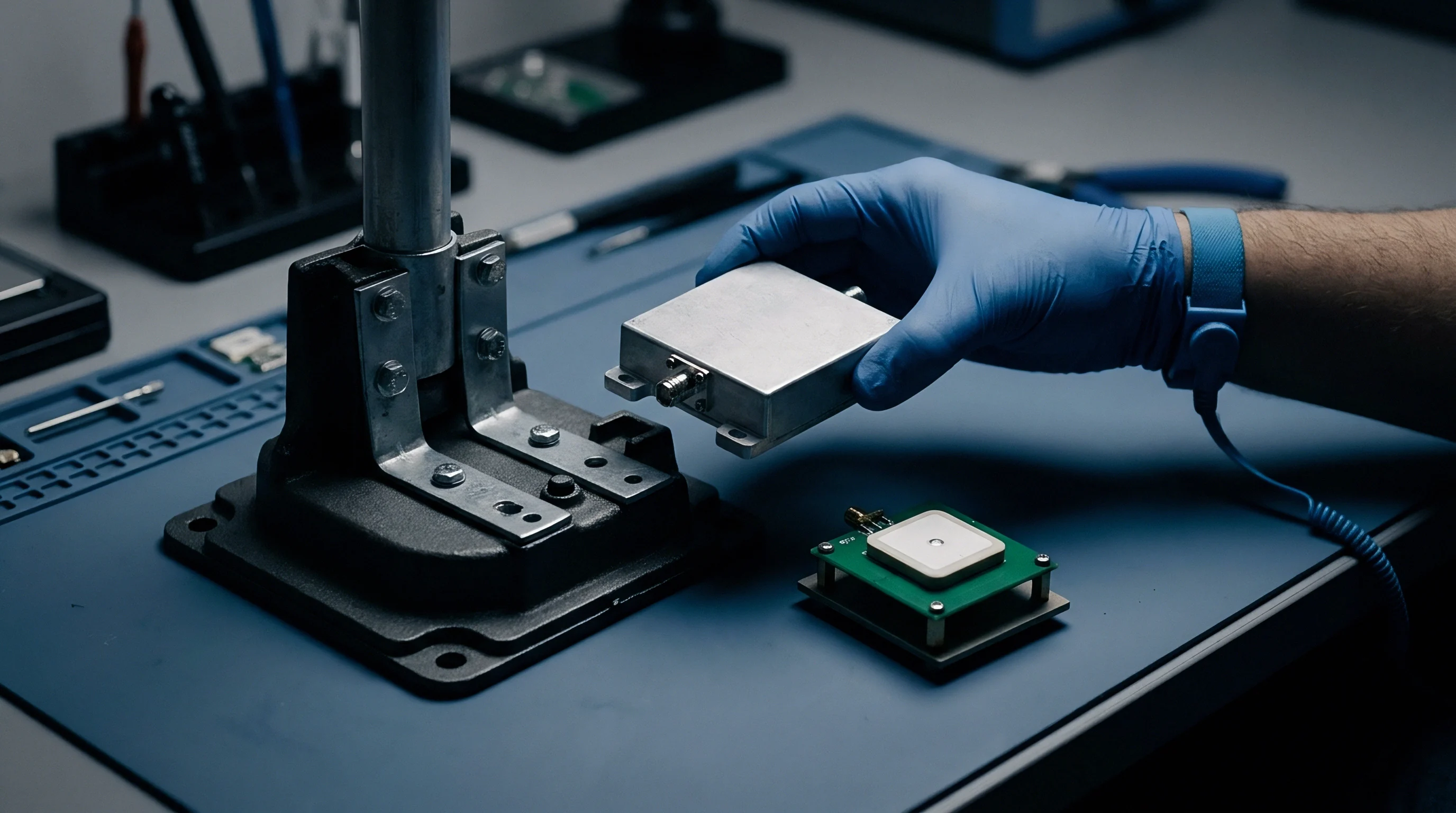
A module configured solely with an integrated PCB trace antenna or an encapsulated ceramic chip antenna fails local test requirements unless the vendor provisions special modified units. Sourcing specifications must oblige the module manufacturer to deliver dedicated test samples fitted with direct 50-ohm coaxial micro-connectors, typically U.FL, IPEX MHF, or SMA pigtails, tapped directly at the radio frequency output pins before the matching network. Radiated spurious emission tests additionally require unshielded housings or modified firmware routines that can defeat internal power management algorithms.

Firmware Test Harness Controls
Standard production firmware contains dynamic power control, frequency hopping, and packet acknowledgment logic. When the module sits on a test turntable inside an anechoic chamber, the test technician must force the radio into non-standard continuous transmission states. The RF engineering team must verify the availability of vendor-supplied command-line test firmware.
- Continuous Wave Transmission Mode locks the module synthesizer to a single unmodulated carrier frequency across low, mid, and high channels, enabling the calibration of absolute power output and carrier frequency stability under varying temperature and voltage conditions.
- Modulated Continuous Transmission forces the baseband processor to output maximum-duty-cycle packets continuously at peak output power, using specific modulation profiles such as orthogonal frequency-division multiplexing (OFDM), Gaussian frequency-shift keying (GFSK), or quadrature phase-shift keying (QPSK).
- Fixed Frequency Channel Hopping Inhibit disables the pseudorandom frequency hopping sequence for Bluetooth, sub-GHz, and proprietary frequency-hopping spread spectrum (FHSS) radios, which allows test engineers to capture dwell time, channel separation, and 20 dB bandwidth on stationary frequencies.
- Continuous Receiver Mode places the transceiver front-end into constant reception state without transmitting acknowledgments, which is necessary to evaluate receiver sensitivity, co-channel rejection, and receiver spurious emissions.

Sample Attrition and Customs Clearance for Prototypes
Domestic testing regimes consume hardware rapidly. Sourcing plans must factor in absolute sample losses during clearance and evaluation. ANATEL evaluations in Brazil typically demand three conducted radio units, two radiated end-product hosts, and distinct accessories including power supplies and external antennas.
Indian MTCTE testing via designated Conformity Assessment Bodies (CABs) requires separate units for safety evaluations under IEC 62368-1, electromagnetic compatibility testing under CISPR 32, and radio parameters under national TEC requirements.
Shipping these engineering development units into developing economies carries severe customs friction. Customs brokers in Brazil, Indonesia, and South Africa systematically seize unapproved radio equipment at the border. Because the prototypes lack an existing type approval registration, standard clearance pathways are locked.
Sourcing and regulatory teams must execute special regulatory waiver procedures, such as obtaining an Import Permit for Testing from the target NRA, alongside ATA Carnet documentation or temporary non-commercial import declarations. Failure to prepare these documents leaves the hardware detained in bonded warehouses, delaying testing slots by eight to twelve weeks.
A module lacking pre-compiled continuous-wave test firmware requires the vendor to supply internal proprietary source code, which foreign national laboratories will flatly refuse to compile or debug.
Procurement agreements must include explicit vendor commitments to supply ready-to-test sample hardware running dedicated test firmware, backed by direct technical support during active chamber scans.


Transfer
When selecting a module for multi-country deployment, the sourcing engineer must audit how easily the component’s existing test artifacts transfer into target country files. Some international regulatory filings transfer efficiently, while others provide minimal leverage.

Leveraging the European RED Test Dossier
The European Union Radio Equipment Directive (2014/53/EU) functions as the structural backbone for paper-based emerging market approvals. Many African, Middle Eastern, and Asian NRAs ~ including South Africa’s ICASA, the UAE’s TDRA, and Nigeria’s NCC ~ operate regulatory frameworks derived directly from European standards. A module that holds a comprehensive RED Technical Documentation file enables swift document-only certification across these states.
Critical gaps emerge depending on which specific ETSI standards appear in the test dossier. Regulators mandate precise standards for specific radio frequency blocks:
| Standard Identifier | Radio Technology / Scope | Core Test Clauses | Paperwork Acceptance Profile |
|---|---|---|---|
| ETSI EN 300 328 | 2.4 GHz ISM (Wi-Fi, Bluetooth, Zigbee) | RF Output Power, Occupied Bandwidth, Out-of-band Emissions | Universally accepted across paper-based NRAs |
| ETSI EN 301 893 | 5 GHz High Performance RLAN | Dynamic Frequency Selection (DFS), Transmit Power Control (TPC) | Scrutinized heavily; DFS test reports must show radar patterns |
| ETSI EN 300 220-1/-2 | Non-specific Short Range Devices (SRD) below 1 GHz | Unwanted emissions, duty cycle, frequency stability | Accepted only where local band plans overlap European frequencies |
| ETSI EN 301 908-1/-13 | IMT Cellular Networks (LTE, NB-IoT) | Radiated spurious emissions, spectrum emission mask | Widely accepted; requires validation of local operating bands |
| ETSI EN 301 489-1/-17/-52 | EMC for Radio Equipment | Radiated and conducted immunity, harmonic current emissions | Universally accepted as proof of electromagnetic compatibility |
If a module vendor executes only partial testing against ETSI EN 300 328 ~ for example, measuring RF output power while omitting receiver blocking evaluations under clause 4.3.2.11 ~ authorities like South Africa’s ICASA will reject the application, demanding a full retest in an accredited laboratory.

Does the FCC Grant Carry Weight in Target Markets?
The Federal Communications Commission (FCC) Equipment Authorization system provides substantial documentary weight across Latin America. Regulators in Mexico (historically), Colombia (CRC), Chile (SUBTEL), and Peru (MTC) accept FCC test reports generated by accredited laboratories under Title 47 of the Code of Federal Regulations (CFR), covering Part 15C, Part 15E, Part 22, Part 24, and Part 27.
Crucially, an FCC Grant does not equal market access on its own. While the underlying test reports verifying compliance with ANSI C63.10 and ANSI C63.26 can serve as paper evidence in bilateral acceptance nations, the administrative grant itself holds zero legal jurisdiction outside the United States. Furthermore, emerging market regulators evaluate whether the test report demonstrates compliance with the full band.
If an FCC test report for a cellular module shows testing restricted strictly to US cellular bands (such as Bands 2, 4, 12, and 13), the filing engineer cannot use that report to secure certification in markets where the module must transmit across Band 1, Band 3, or Band 20. Sourcing specifications must mandate full-band worldwide test reports from the module supplier, rather than a limited domestic US certification package.

The Bureaucratic Friction of Test Report Age
A hidden trap in paperwork transfer is test report shelf life. Western modular approvals, once granted, remain valid indefinitely unless underlying standards change or the physical silicon shifts. Emerging market regulators view aging documentation with extreme skepticism.
Authorities in Indonesia, Thailand (NBTC), and Argentina (ENACOM) reject test reports dated more than two, three, or five years prior to the application submission date.
When selecting a mature, highly cost-effective wireless module designed several years ago, the sourcing team must inspect the original test report issuance date. If the vendor completed its laboratory evaluations in 2018, the reports are invalid for new filings in jurisdictions enforcing document recency rules. Securing fresh certificates requires the vendor to commission complete test reruns in an accredited facility at significant expense.
Sourcing contracts must stipulate that module vendors maintain current, updated test documentation reflecting recent standard revisions.
A vendor stating their existing European CE dossier guarantees global market clearance simply leaves the product development team holding the bill when regional authorities demand entirely fresh local scans.


Sovereignty
Several influential emerging economies enforce strict telecommunications sovereignty. In these territories, international documentary transfers are entirely disregarded, and foreign modular grants carry zero administrative validity. Sourcing evaluation requires pricing the friction of these closed ecosystems directly into the bill of materials.

Brazil: The ANATEL Certification Mechanism
Brazil’s Agência Nacional de Telecomunicações enforces an intensely protected domestic approval pipeline governed by Resolution 715. ANATEL does not accept foreign test reports for commercial equipment. Every wireless transceiver entering the Brazilian market must secure a Certificate of Homologation.
The certification pathway operates through a designated third-party certification body, known as an Organismo de Certificação Designado (OCD). The OCD contracts an accredited Brazilian laboratory (Laboratório Credenciado) to execute in-country testing according to strict local operating acts. Testing of Wi-Fi and Bluetooth equipment follows Act No. 14448, which dictates rigorous evaluations of radiated and conducted spurious emissions, spectrum emission masks, and specific absorption rate (SAR) metrics if used within 20 cm of the human body.
A severe friction point sits in ANATEL’s host integration policy. Brazil classifies modules into two distinct frameworks: strictly restricted modular approvals and full certifications. If a module vendor obtains an ANATEL homologation certificate, that certificate often applies strictly to the bare module.
When the module is placed inside a final host enclosure with its own power supply circuitry, the OCD frequently demands that the host device undergo complete radiated emissions testing under Act No. 1120 (EMC) and Act No. 950 (Electrical Safety), alongside partial radio frequency re-evaluations. Sourcing a pre-homologated module in Brazil reduces documentation friction, but it rarely eliminates host-level testing inside local laboratories.

India: The Dual Barrier of WPC and TEC MTCTE
Deploying a connected device into India requires navigating two parallel regulatory bodies within the Department of Telecommunications (DoT): the Wireless Planning and Coordination (WPC) wing, and the Telecommunication Engineering Centre (TEC).
WPC oversees spectrum licensing and equipment type approval (ETA). For equipment operating in de-licensed frequency bands ~ including 2.4 GHz and 5 GHz Wi-Fi ~ the WPC operates a self-declaration portal for products bearing valid ISO/IEC 17025 test reports from foreign laboratories. This self-declaration route applies only to ETA.
Sourcing teams frequently stop their analysis here, believing their regulatory pathway is clear.
The secondary barrier is the Mandatory Testing and Certification of Telecom Equipment (MTCTE) regime managed by TEC. MTCTE requires that equipment undergo rigorous physical testing inside local Indian laboratories accredited by the National Accreditation Board for Testing and Calibration Laboratories (NABL) and designated by TEC. The technical requirements, known as Essential Requirements (ER), cover radio parameters, electromagnetic compatibility (EMC), information technology safety, and increasingly, national technical security requirements.
- The importer or local manufacturer registers the entity on the centralized MTCTE portal, requiring an active corporate tax profile and authorized Indian signatory.
- Physical production-grade samples pass customs via an MTCTE test sample import letter, arriving at an accredited domestic testing laboratory.
- The laboratory executes mandatory safety testing against IEC 60950-1 or IEC 62368-1, EMC scans against CISPR 32, and radio performance against designated interface requirements.
- Test reports are uploaded directly by the laboratory to the TEC portal, completely bypassing the applicant to prevent data modification.
- TEC evaluates the test data, demands payment of regulatory evaluation fees, and issues an MTCTE certificate with a mandatory five-year validity cycle.
Crucially, TEC treats the finished end-product as the regulated item under MTCTE. Even if the integrated wireless module carries individual WPC ETA approval, the finished product must undergo complete MTCTE certification if it falls within the expanding phases of the regulated equipment list.

Indonesia: The SDPPI Digital Certification Pipeline
Indonesia’s Direktorat Jenderal Sumber Daya dan Perangkat Pos dan Informatika (SDPPI) regulates all radio frequency devices under Regulation of the Minister of Communication and Informatics No. 16 of 2018. SDPPI maintains a dual approach: testing within the national Balai Besar Pengujian Perangkat Telekomunikasi (BBPPT) laboratory in Depok, or documentation submission through recognised foreign test houses.
While SDPPI publishes a list of recognized international laboratories, this recognition list is subject to sudden bureaucratic revisions. If a module’s test reports originate from an unlisted facility, the applicant must import samples directly into Indonesia for full physical testing. Furthermore, SDPPI systematically rejects foreign modular transfer for host integration.
If an OEM integrates a fully SDPPI-certified Bluetooth module into an industrial monitor, the complete industrial monitor must be submitted for a separate, end-device SDPPI certificate. The certification does not transfer through the supply chain.
These sovereignty regimes require sourcing teams to factor domestic laboratory booking backlogs, customs bonds, and local agency costs into their upfront business cases.

Entity
Type approval certificates are not borderless electronic documents owned in a vacuum. A type approval certificate is a legal license to market and import radio apparatus, granted by a sovereign government to an accountable legal entity residing inside that country’s borders.

The In-Country Representative Requirement
With rare exceptions, emerging market regulators mandate that the certificate holder be a locally incorporated corporate entity. ANATEL in Brazil requires a Brazilian corporate tax ID (CNPJ). The Indian WPC and TEC mandate an Indian company with an active Goods and Services Tax (GST) registration.
Indonesia’s SDPPI requires an entity registered within the national Online Single Submission (OSS) system holding an active Business Identification Number (Nomor Induk Berusaha – NIB). South Africa’s ICASA demands a local company holding relevant telecommunications service licenses or equipment dealer registrations.
Foreign original equipment manufacturers (OEMs) lacking corporate infrastructure in these territories must resolve this structural obstacle. Three procedural models exist in the field, each carrying severe operational trade-offs:
- Distributor-Held Approvals assign the regulatory certificate directly to the local sales distributor or commercial partner. This approach eliminates immediate out-of-pocket costs for corporate setup, but it grants the distributor legal control over product importation. If the commercial relationship terminates, the foreign OEM cannot legally clear hardware through customs using another partner without an explicit transfer of ownership, which the original distributor can legally refuse to sign.
- Third-Party Commercial In-Country Representatives utilize independent compliance service companies who act as local holders of the certificate for an annual retainer fee. This maintains OEM commercial independence across multiple sales channels, though it introduces recurring landed overhead and demands absolute trust in the agent’s regulatory standing.
- Direct Corporate Subsidiary Incorporation establishes a formal foreign office in the territory, creating an uncompromised regulatory and supply vehicle. This path requires extensive capital expenditure, local tax filings, and ongoing administrative reporting, rendering it viable only for high-volume commercial programs.

Physical and Electronic Marking Mandates
Achieving the regulatory grant does not conclude legal risk. The physical marking of the module and its host product represents the most active point of customs enforcement. Emerging market authorities reject generic FCC or CE mark conventions, demanding specific territorial symbols, registry numbers, and QR-code routing protocols.
A customs inspector at the port of Santos in Brazil seizes incoming hardware when the physical ANATEL homologation seal lacks the precise dimensional font ratios mandated by Act No. 4088.
The label requirements for core territories impose precise layout and material constraints:
Brazil requires the full ANATEL mark, consisting of the stylized ANATEL logo followed by the homologation number formatted as HHHHH-AA-FFFFF, along with the mandatory warning statement regarding harmful interference for Class II equipment. If the product is smaller than a standard handheld device, ANATEL permits the label to sit inside the official user manual, provided the module itself carries the micro-homologation mark on its metal shield.
India’s TEC mandates that MTCTE-approved products bear the designated TEC label containing the unique certificate number, company name, and the official certification logo. WPC approvals demand printing the ETA certificate number explicitly on the external packaging or product casing.
Indonesia enforces strict physical labeling on the finished product, packaging, and digital interfaces. The SDPPI mark requires the certificate number and the PLG ID (customer ID) to be permanently printed on the equipment enclosure and retail box. SDPPI technicians conduct post-market retail audits; discovering equipment without the printed label triggers immediate administrative fines and license revocation.
The module selection criteria must assess whether the component vendor provides sufficient physical surface area on the radio shielding to laser-etch secondary market certification marks, or whether the vendor supports dynamic electronic labels (e-labeling) visible through a host device display during boot sequences.
Failing to verify housing space for regional compliance logos forces costly mechanical tool modifications late in the tooling phase.


Ledger
Assessing the commercial profile of a wireless module based solely on its unit bill-of-materials cost ignores the reality of market-entry economics. Sourcing decisions must rely on a calculated landed cost of compliance, integrating lab charges, agency retainers, translation fees, and mandatory recurring renewals.

Worked Cost Model: Global Sourcing Economics
To demonstrate the economic mechanisms, evaluate a concrete sourcing scenario. A mid-sized hardware manufacturer plans to produce an industrial telematics controller deployed across five core emerging territories: Brazil, India, Indonesia, South Africa, and Mexico. The engineering team evaluates two component options:
Option Alpha is an unbranded, low-cost multi-protocol (Wi-Fi 4 + BLE 5.0) system-on-chip module priced at $3.20 per unit at a 50,000-unit annual volume. The vendor holds basic FCC Part 15C and incomplete CE reports, with no existing emerging market homologations, no local laboratory ties, and no in-house regulatory support staff.
Option Beta is a tier-one wireless module priced at $5.80 per unit at the same volume. The vendor maintains complete ETSI EN 300 328 and EN 301 489 reports, active ANATEL homologation, WPC ETA self-declaration files, and an engineering team dedicated to providing conducted test firmware and chamber schematics.
Assume the host controller integrates the module unaltered, keeping antenna configurations identical to the supplier’s reference designs. The certification costs for Option Alpha and Option Beta diverge dramatically across the target territories:
| Cost Component / Jurisdiction | Option Alpha (Raw Silicon) | Option Beta (Pre-Approved File) | Variance Driver |
|---|---|---|---|
| Brazil (ANATEL: OCD + Lab Testing) | $22,500 | $7,500 | Full radio tests vs. simplified host EMC sweep |
| India (WPC ETA + TEC MTCTE) | $14,000 | $6,200 | Full domestic RF scans vs. inherited ETA and safety |
| Indonesia (SDPPI: In-country / Lab) | $11,500 | $4,800 | Domestic physical lab testing vs. recognized paper file |
| South Africa (ICASA: Evaluation) | $4,200 | $1,800 | Fresh test report generation vs. direct CE acceptance |
| Mexico (IFT: Local Testing Nom-121) | $16,000 | $5,500 | Full accredited lab trial vs. modular transfer |
| In-Country Representative Retainers | $12,000 | $12,000 | Flat local agent baseline across 5 territories |
| Sample Attrition and Logistics | $6,500 | $2,200 | High sample burn rate for uncertified silicon |
| Total Upfront Certification Expense | $86,700 | $40,000 | Direct out-of-pocket approval spend |
The upfront cash delta between the two sourcing strategies sits at $46,700. Now examine how this affects total unit economics over an initial production run of 20,000 units delivered across the first operational year:
For Option Alpha, the pure module procurement cost is $64,000 ($3.20 multiplied by 20,000). Adding the regulatory approval ledger of $86,700 drives the total effective landed component cost to $150,700, yielding a true per-unit cost of $7.54.
For Option Beta, the initial procurement spend is $116,000 ($5.80 multiplied by 20,000). Adding the reduced regulatory ledger of $40,000 yields a total landed cost of $156,000, establishing a true per-unit cost of $7.80.
At 20,000 units, Option Alpha appears to preserve a marginal advantage of $0.26 per unit. This thin margin dissolves entirely once schedule execution delays enter the calculation.

Schedule Slippage and Revenue Impact
Executing five simultaneous in-country testing campaigns for Option Alpha requires managing local laboratory booking backlogs. In Brazil and India, laboratory availability for uncertified wireless transceivers routinely exhibits lead times ranging from ten to sixteen weeks. Preparing test firmware, resolving chamber anomalies, and clearing customs for unapproved prototypes consumes substantial engineering overhead.
The timeline for Option Alpha to achieve full commercial clearance across all five target territories averages twenty-six weeks. For Option Beta, leveraging pre-existing test files and modular homologations reduces the approval timeline to twelve weeks. The difference is a fourteen-week market entry delay.
In commercial deployments with fixed deployment contracts, a fourteen-week launch postponement destroys far more gross margin than the initial $0.26 bill-of-materials spread.
Sourcing analysis must treat approval lead time as a direct variable of the component cost, rather than an administrative externality managed by a downstream department.
The procurement contract must incorporate regulatory service-level agreements, compelling the vendor to indemnify the buyer if technical deficiencies in the vendor’s modular files cause local regulatory rejection.


Longevity
Securing an initial grant of type approval ensures market access only until the certificate’s mandatory expiration date or the first internal component change. Emerging market regulators view wireless approvals as temporary revenue instruments, requiring continuous recertification, ongoing factory surveillance, and rigorous change control management.

Validity Cycles and Renewal Upkeep
Western certifications rarely expire. An FCC grant remains legally valid indefinitely, provided the product continues to match the approved characteristics. In contrast, emerging market type approval certificates expire on rigid legislative schedules, imposing an ongoing operational tax on the supply chain.
ANATEL homologations in Brazil feature stratified validity windows depending on product classification. Equipment classified under Category II ~ which includes most Wi-Fi, Bluetooth, and non-cellular spread-spectrum radios ~ historically requires certificate renewal every two years. Renewal involves an administrative review, proof that the manufacturing facility remains compliant, and occasionally, supplemental lab testing.
Other territories operate similar cycles: South Africa’s ICASA grants permanent certificates for unchanged equipment, but India’s TEC MTCTE certificates carry a strict five-year expiration. Indonesia’s SDPPI certificates remain valid for three years, requiring full re-registration thereafter.
Managing an international deployment requires tracking these staggered expiration dates inside an enterprise compliance ledger. If an ANATEL certificate lapses while a container ship is en route to Rio de Janeiro, Brazilian customs agents deny entry upon arrival. The shipment cannot be cleared using an expired registration, and goods must either be returned to the origin port or destroyed under customs supervision.

Silicon Revisions and PCN Exposure
The most acute operational vulnerability in long-lifecycle deployments is the module vendor’s silicon supply chain. A semiconductor fab transition, an internal low-dropout (LDO) regulator replacement, or an RF matching inductor swap triggers a Product Change Notification (PCN).
Under FCC rules, a minor component change frequently qualifies as a Class I or Class II Permissive Change (C2PC). If radiated emissions shift slightly but remain within legal thresholds, the vendor files a C2PC without altering the FCC ID. Host manufacturers rarely need to modify their commercial documentation.
Emerging market NRAs rarely recognize foreign permissive changes. In Indonesia, Mexico, and Brazil, any change to the internal Bill of Materials (BOM) that affects the integrated circuit part number, internal trace layout, or RF output characteristics legally invalidates the original type approval certificate. The regulator considers the updated hardware a completely new model, necessitating a new application, fresh test samples, and full laboratory fees.
When selecting a wireless module, the engineering team must scrutinize the vendor’s component longevity roadmap. Low-cost vendors frequently swap internal passive components, power amplifiers, or flash memory between manufacturing batches to chase lowest-cost silicon. Each silent revision represents an impending regulatory violation across emerging markets.
The sourcing specification must contain rigid change-control clauses requiring the module vendor to provide a minimum twelve-month advance notice of any hardware, firmware, or silicon modifications that could invalidate international type approvals.


Vetting
Protecting a commercial deployment across developing markets requires translating regulatory risks into an actionable procurement audit. Hardware selection teams must subject potential module suppliers to a structured pre-award qualification process before issuing purchase orders.

Pre-Procurement Regulatory Audit Checklist
Engineers and sourcing managers should execute this procedural qualification sequence across candidate module vendors:
- The engineering lead reviews the vendor’s primary test dossiers, demanding complete, unredacted ISO/IEC 17025 laboratory reports rather than two-page marketing certificates.
- The radio frequency specialist audits the underlying test reports for full-band coverage, verifying that testing covers national allocations in Brazil, India, and Southeast Asia rather than restricted regional bands.
- The firmware architect inspects the supplier’s test firmware distribution, ensuring compiled binaries exist for low-level continuous-wave and continuous-packet transmission modes via standardized serial command interfaces.
- The compliance manager verifies the validity of the vendor’s existing international certificates, checking issuance dates against local three-year and five-year expiration cliffs.
- The procurement officer reviews the module vendor’s component longevity policy, securing written contractual guarantees regarding minimum manufacturing lifetimes and formal Product Change Notification advance windows.

Contractual Allocation of Compliance Risk
Standard terms and conditions leave the buyer fully liable for all downstream certification failures. When purchasing wireless modules destined for integration and emerging market export, the buyer must insert explicit compliance obligations directly into the Master Supply Agreement (MSA).
The contract must require the supplier to provide ongoing regulatory engineering support. If an in-country laboratory in Brazil or India encounters anomalies during homologation scans, the module vendor must provide direct, SLA-bounded engineering support to resolve firmware commands or chamber setup issues. If the module fails a local standard due to an unannounced silicon or passive component change executed by the supplier, the contract must obligate the vendor to reimburse all local re-testing fees, administrative fines, and associated sample freight costs.
Furthermore, sourcing agreements should stipulate that the vendor provide open access to their regulatory files. Many low-tier module suppliers refuse to share raw schematics, internal block diagrams, or detailed test reports, citing intellectual property protection. Because national regulators in Brazil, India, and Mexico legally demand these schematics as mandatory exhibits in the type approval filing, a vendor’s refusal to supply them under a strict Non-Disclosure Agreement instantly stalls the approval pipeline.
Choosing a wireless module for emerging territories is fundamentally an exercise in regulatory risk management. The lowest purchase price per unit provides zero financial shelter when a shipment sits impounded in customs, blocked by an incompatible band, an expired certificate, or an uncooperative supplier.
Changing national data protection and hardware security mandates across developing states are already moving to merge cyber-resilience audits directly into the baseline radio type approval gate.