Quantifying Micro Jump Phase Discontinuities in Temperature Compensated Oscillators under Rapid Thermal Transients
Dynamic temperature ramps induce TCXO micro-jumps that degrade phase margin, demanding physical thermal shielding and strict phase-step RFQ caps.
Shock
Crystal Blank Stress Dynamics under Rapid Temperature Gradients
Thermal transients exceeding one degree Celsius per second set up steep spatial gradients across the quartz crystal blank in a Temperature Compensated Crystal Oscillator (TCXO). These gradients upset the mechanical stress equilibrium of the AT-cut or SC-cut quartz plate, producing local strains before the crystal can settle into thermal equilibrium. The oscillator’s analog or digital compensation circuit monitors an internal or package-adjacent thermistor.
Because this sensor carries a thermal time constant between 50 milliseconds and 300 milliseconds while the quartz reacts to localized mechanical stress almost instantly, the compensation circuit tracks a lagged temperature profile rather than the true state of the blank.
During rapid heating or cooling, the correction voltage applied by the compensation network corresponds to a temperature the quartz has already cleared or not yet reached. The resulting frequency error distorts the nominal frequency-versus-temperature curve. When accumulated shear stress releases along structural boundaries, mounting clips, or internal bonding wires, the blank undergoes microscopic stress relief events.
These produce abrupt, discontinuous frequency jumps, typically measured between 0.05 parts per million and 1.5 parts per million over intervals under ten milliseconds.
Transient thermal gradients across a quartz plate shift the resonant mechanical frequency faster than an integrated compensation loop can sample the onboard thermistor.
Digital temperature compensated oscillators (DTCXOs) show an additional quantization stepping artifact. Look-up tables update the tuning capacitance through a digital-to-analog converter (DAC) or switched capacitor matrix at predetermined temperature boundaries. As a rapid thermal sweep crosses these thresholds, the discrete bit steps introduce abrupt phase jumps directly into the RF output.
The severity of these phase jumps depends on DAC resolution, calibration grid density, and the prevailing rate of temperature change dT/dt.
Micro-Jump Failure Modes in Precision Timing
Micro-jumps degrade short-term frequency stability, directly disturbing high-order phase synchronization over physical radio links. Receiver synthesizers must absorb the full magnitude of the phase step within their phase-locked loops (PLLs). The underlying physical and circuit mechanisms split into several distinct categories.
- Stress relaxation jumps occur when shear stress accumulated within the crystal mounting structure releases abruptly, altering the resonant frequency without warning.
- Thermal compensation quantization steps stem from discrete look-up table bit transitions within digital compensation ASICs during steep thermal ramps.
- Activity dip crossings emerge when quartz coupled modes intersect the main vibrational mode at specific temperatures, causing coupled-mode energy transfer.
- Sensor gradient lags result from mismatch between the thermistor thermal mass and the quartz blank thermal mass during high ambient airflow changes.
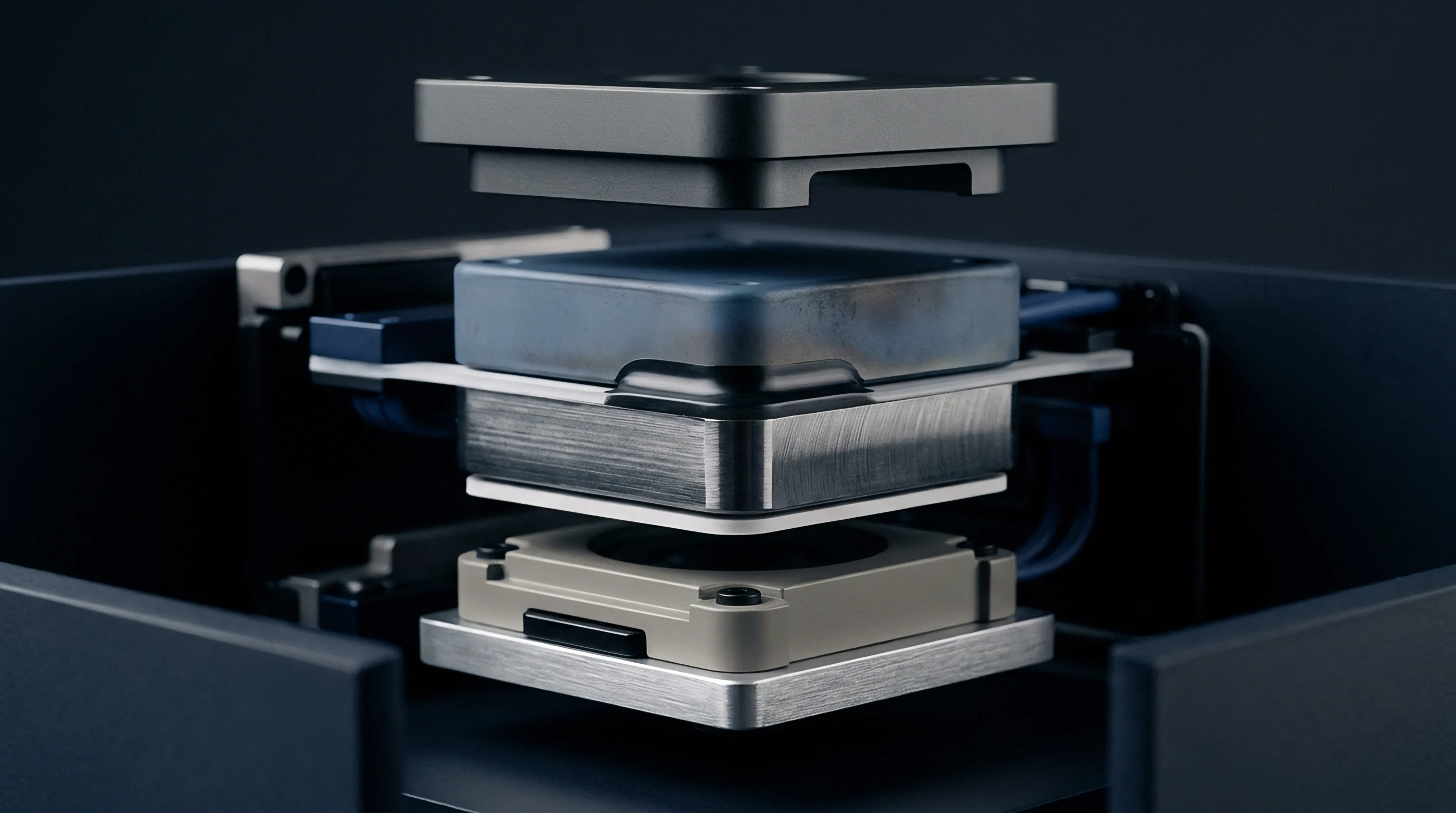
Activity dips are particularly troublesome because they introduce localized, high-Q mechanical damping at fixed temperatures. Pushing a TCXO through an activity dip at three degrees Celsius per second can generate phase rate discontinuities greater than thirty degrees within a single millisecond. Resonator packaging research continues to investigate whether full envelope isolation can shield the quartz blank from transient boundary shear stresses during extreme ambient shock.

Drift
Phase Discontinuity Quantification Metrics
Detecting micro-jumps requires high-rate time-domain phase sampling rather than standard frequency counting. An instrument averaging over a one-second gate interval completely hides a fifty microseconds jump, blending the event into baseline drift. High-speed phase demodulation, continuous time-interval analysis, and overlapping Allan deviation are needed to capture the fast trajectories responsible for symbol errors.
An instantaneous phase discontinuity Δφ in radians relates directly to the integrated fractional frequency anomaly Y(t) across the transient window duration T. The mathematical expression takes the following form:
Δφ = 2π f0 ∫ Y(t) dt
Here, f0 represents the nominal center frequency of the oscillator in Hertz. A 26 MHz TCXO experiencing an abrupt 0.8 parts per million frequency jump for two milliseconds accumulates roughly 0.261 radians of instantaneous phase error, or 14.9 degrees. In phase-sensitive constellations, a 15 degrees shift degrades the vector error magnitude (EVM) enough to throw the received symbol across its decision boundary.
| Oscillator Topology | Nominal Frequency | Transient Rate (dT/dt) | Peak Micro-Jump (ppm) | Maximum Phase Discontinuity |
|---|---|---|---|---|
| Analog TCXO (Direct Compensation) | 26.0 MHz | 5.0 °C/min | 0.08 ppm | 4.2 degrees |
| Digital TCXO (10-bit DAC Table) | 26.0 MHz | 5.0 °C/min | 0.45 ppm | 22.8 degrees |
| Digital TCXO (14-bit DAC High Precision) | 38.4 MHz | 5.0 °C/min | 0.12 ppm | 9.1 degrees |
| Ultra-Low Noise Analog TCXO | 19.2 MHz | 5.0 °C/min | 0.03 ppm | 1.8 degrees |
Time deviation (TDEV) and time interval error (TIE) isolate these short-lived anomalies clearly. TIE monitors cumulative phase walk between the oscillator edge and a reference clock. Under stable temperatures, TIE climbs predictably with phase noise and flicker frequency modulation.
A rapid thermal front produces a distinct, non-linear shelf in the trace: the slope gives the peak frequency excursion, and the shelf height measures the net phase jump.
Short-Term Frequency Stability Impact
Thermal transitions severely degrade short-term Allan deviation σy(τ) at integration intervals τ between 1 millisecond and 100 milliseconds. Under static conditions, a high-grade 26 MHz TCXO typically shows an Allan deviation near 10 to the power of minus 11 at 100 milliseconds. Subjected to a thermal ramp of three degrees Celsius per minute, localized phase jumps push short-term stability worse by two to three orders of magnitude, often exceeding 10 to the power of minus 8.
Quantization steps inside a digital compensation loop corrupt short-term Allan deviation measurements before long-term drift can be detected.
Baseband tracking loops counter phase drift through continuous carrier recovery adjustments. If the phase-locked loop bandwidth is narrower than the inverse duration of the micro-jump, the loop slips cycle and drops frame sync. Widening the bandwidth maintains tracking through rapid steps, but admits wider phase noise from the local oscillator into the demodulator.
Setting loop bandwidth without knowing the worst-case phase slope under temperature routinely leads to unexpected dropped packets in field deployments.
Oscillators with continuous analog compensation curves maintain smooth phase trajectories compared to digitized compensation topologies.


Symbol
Impact on Narrowband and Sub-GHz Wireless Protocols
Narrowband architectures rely heavily on stable symbol timing and consistent phase references. Operating across sub-GHz allocations like 868 MHz and 915 MHz, these links use symbol rates from a few hundred baud to several tens of kilobaud across narrow channel widths of 6.25 kHz, 12.5 kHz, or 25 kHz. Under such narrow channel filtering, any sudden phase step causes immediate inter-symbol interference and transient carrier offset.
For example, an ultra-narrowband link running at 100 bps with binary phase-shift keying (BPSK) at 868 MHz allocates 10 milliseconds to each symbol. A micro-jump midway through the symbol that steps phase by 30 degrees degrades Eb/N0 by over 1.2 dB. On an operating link running with a thin 3 dB margin above sensitivity, that single jump wipes out forty percent of the headroom and forces a burst of bit errors.
In frequency-shift keying (FSK) and Gaussian frequency-shift keying (GFSK) networks, such as those standard in legacy telemetry, phase steps appear as instantaneous frequency spikes. A sudden jump Δf during symbol integration biases the discriminator output voltage; if that spike exceeds half the channel deviation, the detector logs a false bit transition and drops the frame on a CRC failure.

Cellular IoT Phase Slip and Frame Error Mechanics
Cellular IoT standards like LTE Cat-M1 (LTE-M) and Narrowband IoT (NB-IoT) build on Orthogonal Frequency Division Multiplexing (OFDM) and Single-Carrier Frequency Division Multiple Access (SC-FDMA). NB-IoT allows subcarrier spacings of 15 kHz or 3.75 kHz. At 3.75 kHz, the symbol period stretches to 266.67 microseconds with a 6.67 microseconds cyclic prefix, leaving little tolerance for uncorrected frequency offset at the base station receiver.
During maximum transmit power bursts, the power amplifier (PA) dumps substantial heat straight into the board substrate. The thermal energy travels through internal ground copper directly toward the TCXO, generating local gradients up to eight degrees Celsius per second inside small enclosures. The resulting phase step across the LTE frame disrupts subcarrier orthogonality.
These phase discontinuities degrade the channel state derived from Demodulation Reference Signals (DMRS). Because the receiver relies on DMRS symbols to track channel impulse response and phase across the subframe, a TCXO step between reference and payload symbols corrupts the equalization matrix. The equalizer rotates subcarriers incorrectly, collapsing constellation spacing in modulations like 16-QAM.
- Connect the device under test inside a programmable environmental chamber with localized thermal shock probes positioned directly above the TCXO housing.
- Configure an RF signal generator to transmit an unmodulated carrier at the precise operational frequency into a high-speed vector signal analyzer.
- Set the vector signal analyzer to continuous IQ capture mode with a sampling rate exceeding ten mega-samples per second to ensure sub-microsecond time resolution.
- Ramp the local chamber thermal head at ten degrees Celsius per minute while simultaneously recording time-stamped IQ samples across five thermal sweep cycles.
- Extract the instantaneous phase trajectory using off-line Hilbert transform analysis and filter out static carrier frequency offsets using a second-order polynomial baseline fit.
- Identify discrete phase discontinuities exceeding five degrees within a sliding one-millisecond window and calculate the peak phase jump rate dφ/dt.
When LTE Cat-M1 user equipment experiences a phase jump exceeding 18 degrees within one subframe, block error rate (BLER) jumps from under one percent to over forty percent. The base station requests retransmissions via Hybrid Automatic Repeat Request (HARQ). Multiple consecutive HARQ failures force the radio link control (RLC) layer to re-establish the connection.
The radio re-enters the random access channel (RACH) phase, consuming battery power and extending transmit airtime by orders of magnitude.
A single uncompensated phase step during an LTE subframe invalidates channel estimation and triggers immediate HARQ retransmission cascades.
A cellular module maintaining an active link at -118 dBm receiver sensitivity fails entirely when local oscillator thermal steps occur during signal tracking windows.
Shield

Thermal Isolation and PCB Physical Layout
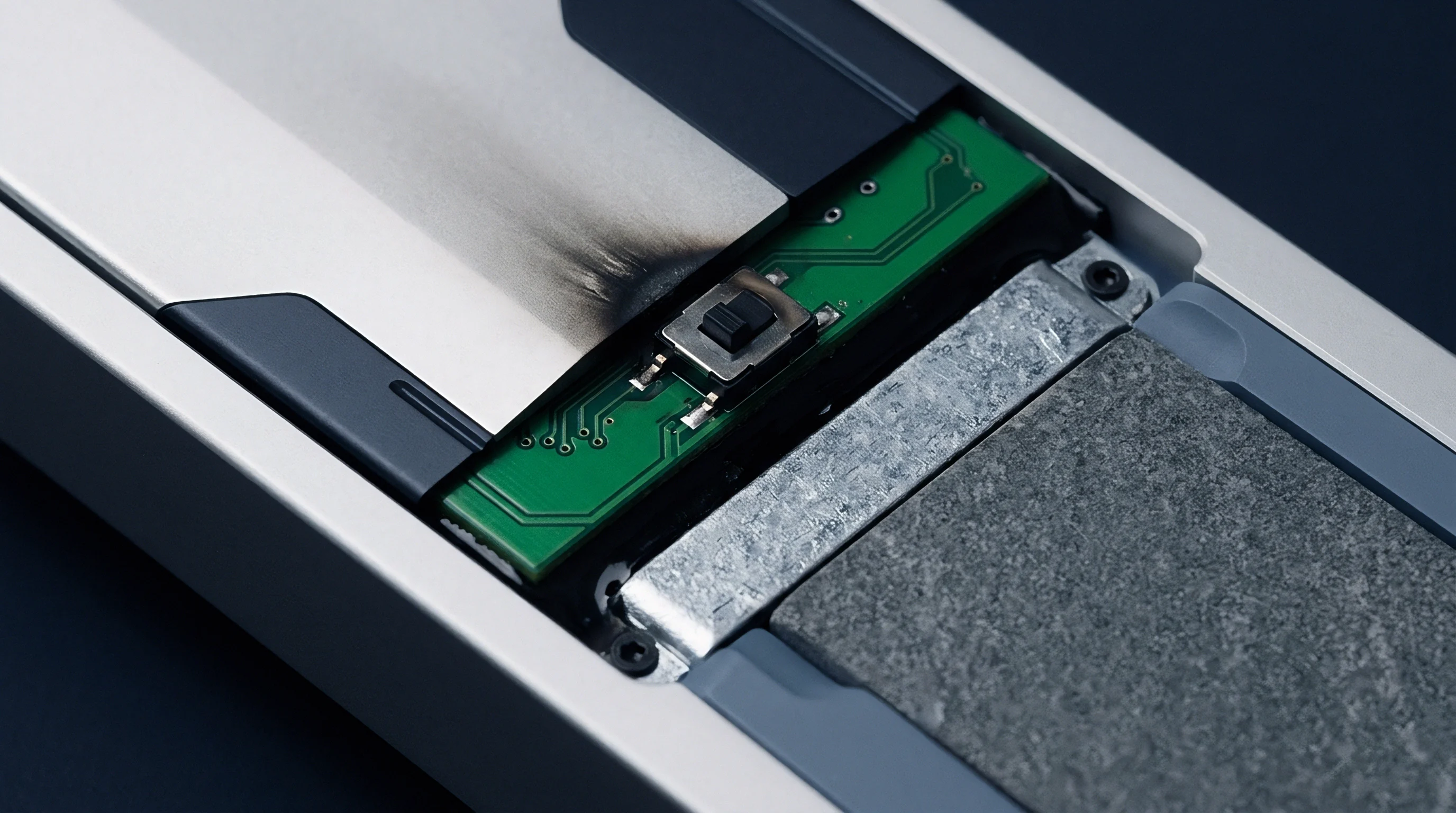
Suppressing micro-jumps requires structural layout intervention on the printed circuit board before relying on software or baseband algorithms. The layout must minimize the thermal rate of change dT/dt reaching the TCXO during ambient cold fronts or heat pulses from nearby power management integrated circuits (PMICs) and power amplifiers.
Placing the oscillator near high-power RF stages guarantees exposure to steep temperature transients. Power amplifiers dump multiple watts of heat into the board within milliseconds of transmission starting, and solid copper planes channel that energy directly to the oscillator footprint. Protecting the TCXO requires physical layout barriers that interrupt these conductive paths.
| Layout Mitigation Technique | Thermal Rate Reduction Factor | Phase Jump Attenuation | Implementation Cost Impact |
|---|---|---|---|
| Thermal Isolation Moat (PCB Cutout) | 3.5x to 5.0x lower dT/dt | 12 dB to 16 dB reduction | Minimal (requires routing keeps) |
| High-Density Thermal Vias to Inner Layers | 1.8x to 2.2x lower dT/dt | 6 dB to 8 dB reduction | Negligible (standard via rules) |
| Metal Shielding Canopy with Molded Foam Filler | 4.0x to 6.5x lower dT/dt | 15 dB to 20 dB reduction | Moderate (component plus placement) |
| Ground Plane Copper Island with Thin Trace Bridges | 2.5x to 3.5x lower dT/dt | 9 dB to 12 dB reduction | Low (requires board area) |
A proven board-level approach uses a routed isolation moat. Milling a three-sided slot through all PCB layers around the oscillator leaves only a narrow neck to carry signal, power, and ground traces. Severing the surrounding copper planes forces conducted heat around a convoluted path, increasing the local thermal time constant from 200 milliseconds to over 3 seconds and flattening the incoming thermal front.
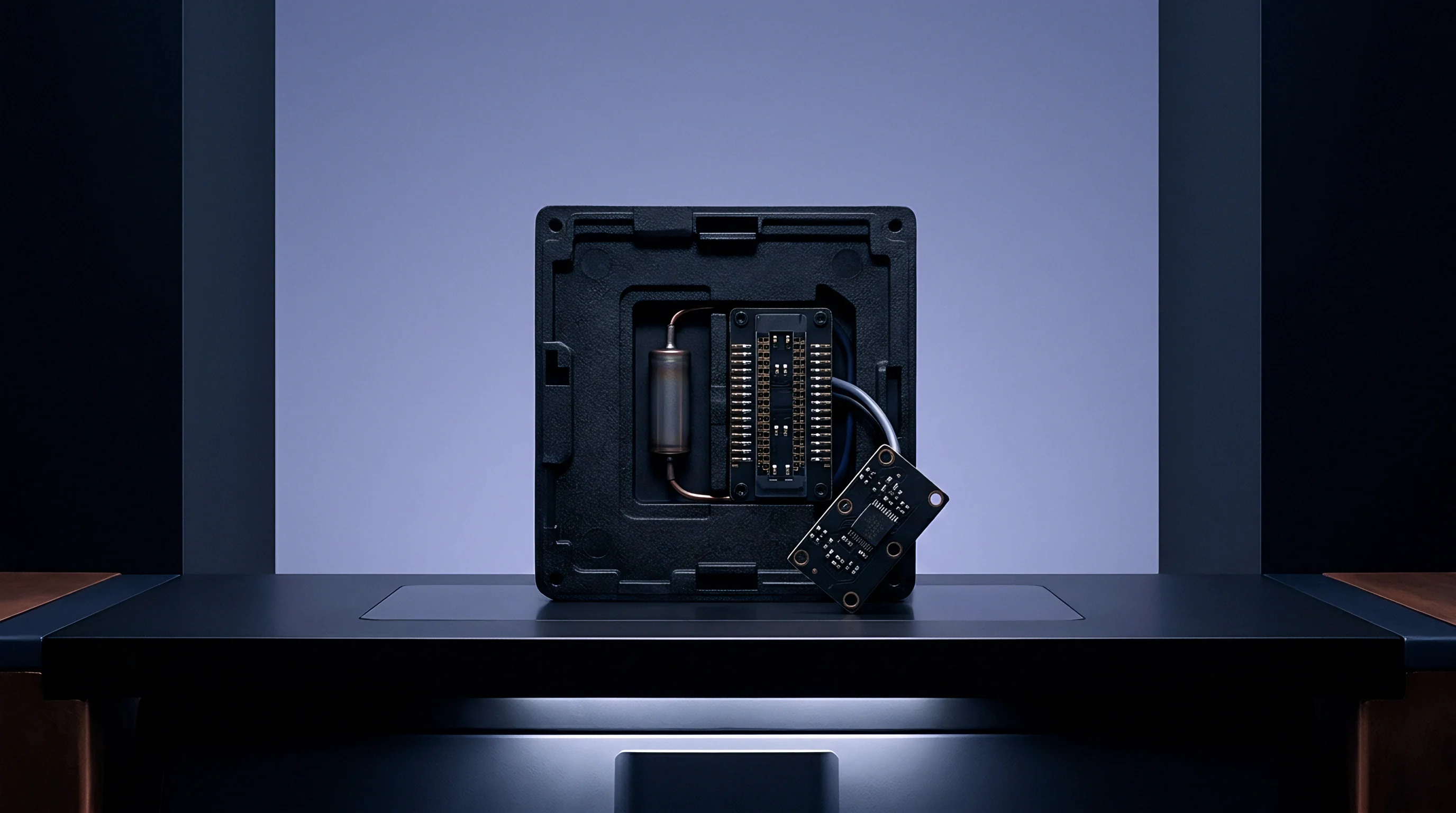
Fitting a metal shield canopy packed with low-conductivity potting compound or micro-cellular foam creates a passive thermal filter over the package. The closed cell core traps air over the case, dampening convection shocks caused by cooling fans or ambient drafts.
Mechanical and Layout Rules
Careful component placement protects sensitive quartz resonators from combined thermo-mechanical stresses that induce micro-jumps.
- Thermal Moat Isolation surrounds three sides of the TCXO footprint with routed slots to break direct copper heat conduction paths.
- Symmetrical Plane Connection uses narrow, balanced trace widths on ground and power pins to equalize thermal expansion stresses across pads.
- Keep-Out Zone Enforcement prevents placement of heat-generating components like PMICs, RF power amplifiers, or switching inductors within 15 millimeters of the oscillator.
- Mechanical Strain Relief avoids placing the TCXO near PCB mounting screws, card edge connectors, or structural flex points where board bending induces mechanical strain into the quartz package.
Soldering the oscillator directly to heavy copper planes without thermal relief traces produces uneven cooling during reflow, locking residual mechanical shear into the ceramic package. Subsequent board temperature shifts cause mismatched thermal expansion between the laminate, solder joints, and ceramic package, prompting sudden stress relief jumps. Symmetrical, necked-down routing balances the solder joints thermally during assembly.
Package mounting stress nominally falls within acceptable limits under standard reflow profiles, yet uneven cooling generates long-term mechanical strain across the package base.
Ledger

Commercial RFQ Specifications for Phase Jump Limits
Standard TCXO datasheets describe temperature stability as a broad static window, often ±0.5 ppm from -40 to +85 degrees Celsius. That envelope masks transient behavior completely. An oscillator can stay well inside ±0.5 ppm overall while firing off repeated 0.2 ppm phase jumps each minute during dynamic heating.
Procurement packages need clear limits on phase change rates to enforce component quality.
A thorough RFQ defines frequency hysteresis, maximum allowable step size under specified thermal ramp rates, and continuous phase noise under temperature cycling. Capping the phase derivative ~ for instance, requiring dφ/dt less than 5 degrees per millisecond under a 5 °C/minute thermal ramp ~ compels vendors to screen parts on automated dynamic test benches.
| Specification Parameter | Standard Datasheet Definition | Enforced Dynamic Specification | Testing Rigor Required |
|---|---|---|---|
| Frequency vs Temperature Envelope | ±0.5 ppm over -40°C to +85°C | ±0.5 ppm overall; max 0.02 ppm/°C slope | Continuous thermal chamber sweep |
| Micro-Jump Discontinuity Cap | Not Specified (Unmeasured) | < 0.05 ppm step size over Δt < 5 ms | High-speed phase tracking analysis |
| Short-Term Allan Deviation (τ=100ms) | Measured at static 25°C baseline | < 5.0 x 10^-10 during 3°C/min ramp | Dynamic thermal rate testing |
| Frequency Hysteresis | Typical 0.2 ppm static return | < 0.08 ppm peak-to-peak loop drift | Dual-direction temperature cycling |
Dynamic screening adds 15 to 35 percent to the unit purchase price of a TCXO. In volume production, that premium must be weighed against field service costs, firmware recovery patches, warranty claims, and dropped-packet SLA penalties.
Cost Modeling and Quality Audit Verification
Evaluating oscillator quality commercially comes down to the lifetime operating cost per deployed node. In smart meter networks, a device that loses synchronization during sharp temperature drops ~ such as fast desert night-time cooling ~ must keep its radio awake longer to reacquire network timing.
Consider an installation of 100,000 smart water meters engineered for a 10-year battery life budget. Operating over NB-IoT, the modems sleep between single daily reporting cycles. A normal wake, attach, and transmit sequence takes 4 seconds at an average current of 120 mA at 3.6 volts.
If thermal micro-jumps trigger attach failures on 2 percent of cold-cycle wakeups, those modems stay active for up to 120 seconds hunting for the network.
Each failed attach sequence consumes 120 seconds times 120 mA, equal to 4.0 milliamp-hours (mAh) of battery capacity. That single retry burns as much energy as 36 normal daily transmissions. Over a 10-year operational lifecycle, an unmitigated 2 percent micro-jump failure rate forces premature battery exhaustion on thousands of meters, incurring field service truck rolls priced between $80 and $150 per site visit.
Spending an extra $0.25 on a higher-grade, micro-jump-screened TCXO per meter prevents premature field failures and preserves link integrity across the operational lifespan.
The supply agreement mandates that suppliers certify component batch compliance using Section 4.8 of the IEEE 1588-2019 standard for dynamic frequency stability, specifying that any lot exhibiting phase steps greater than 0.08 parts per million under a two-degree-per-minute gradient shall be rejected at the vendor factory before shipment.