Quantifying Permissive Change Filing Boundaries under High Density Host Co Location Coupling
Exceeding radiated spurious limits or specific absorption rate thresholds under close antenna co-location mandates a formal Class II Permissive Change filing.

Coupling
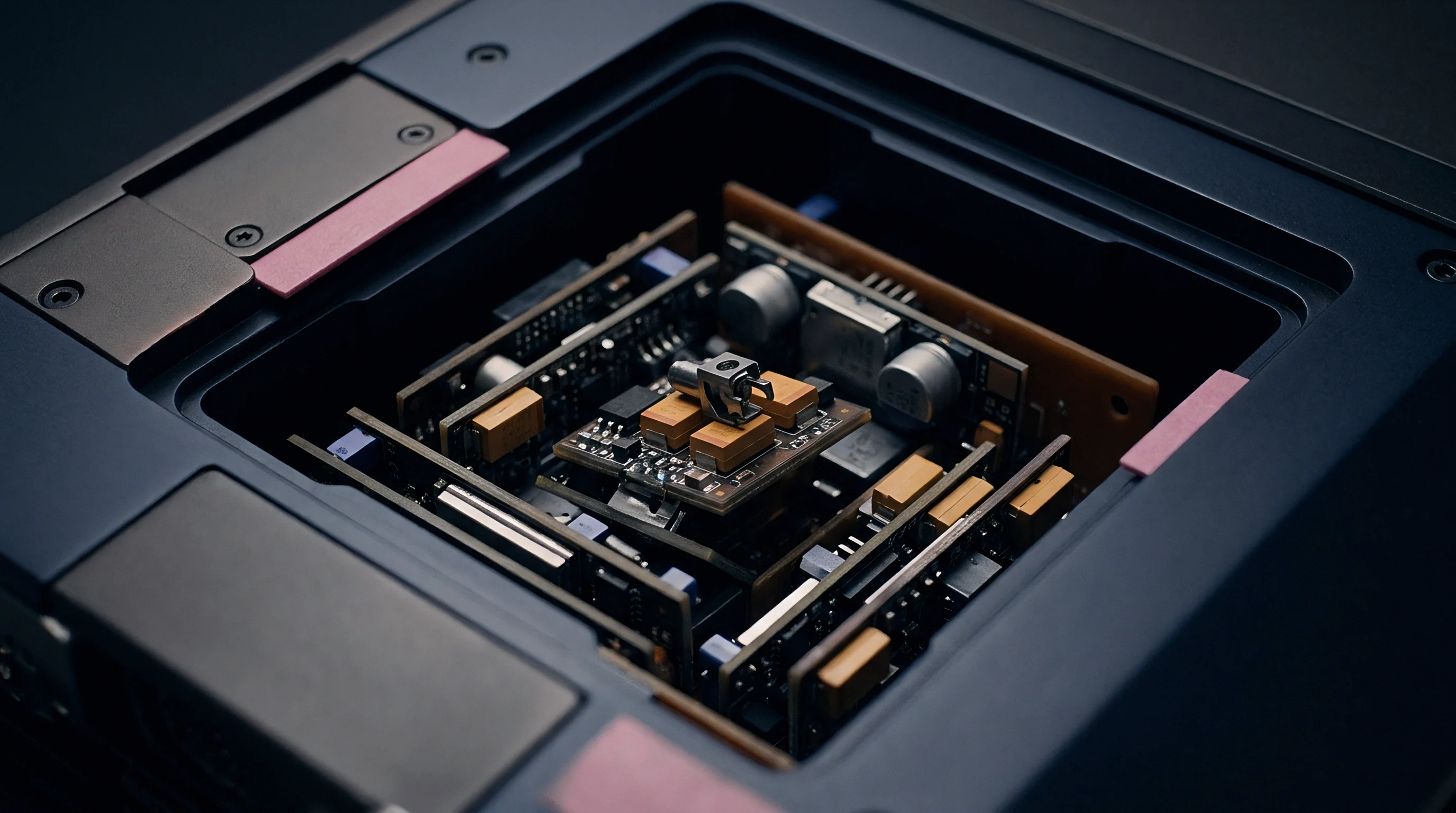
Adjacent transceivers in an enterprise gateway or asset monitor interact through near-field reactive energy and shared ground paths, coupling RF energy across copper planes. When two certified modules sit within twenty millimeters of each other, their antennas no longer act as isolated radiators. Mutual impedance shifts the operating match, pulls the center frequency, and injects transmitter power directly into the reverse termination of the adjacent radio.
Meanwhile, off-channel carriers drive receiver low-noise amplifiers into gain compression, while passive components and semiconductor junctions on the board generate non-linear sum and difference products across multiple bands.
Standalone modular grants issued under FCC Part 15 assume an infinite ground plane and thirty centimeters of clearance from companion intentional radiators ~ conditions that collapse in high-density builds. For instance, running a Wi-Fi 6E module at twenty decibel-milliwatts alongside a sub-gigahertz cellular modem can produce third-order intermodulation products directly inside protected aeronautical or satellite navigation allocations. Harmonic mixing then creates untracked intermodulation spurs.
To manage these interactions, the Federal Communications Commission uses Knowledge Database 996369 D02 and D04 to set strict rules on when an integrator may keep the original modular grant versus when a new filing is required.
Intermodulation spurs exceeding minus thirty-six dBm at five-millimeter separation invalidate standalone transmitter approvals under FCC Part 15 subpart C.
Engineers evaluate physical coupling through four distinct integration vulnerabilities:
- Antenna Aperture Overlap alters radiation patterns, distorts polarization purity, and increases effective isotropic radiated power along unanticipated spatial vectors.
- Ground Plane Current Injection spreads radio-frequency noise across digital return paths, raising broadband noise floors during simultaneous packet transmissions.
- Enclosure Cavity Resonance recirculates electromagnetic fields within compact metal or metallized plastic shells, aggravating reactive coupling between unshielded surface-mount components.
- Power Distribution Rail Ripple carries supply voltage dips from cellular burst transmissions into sensitive frequency synthesizers, widening transmitter phase noise skirts.
When chamber scans detect unexpected sidebands and integration alters the original emission profile, the regulatory classification changes instantly from an unmodified host system to a co-located multi-transmitter system. Integrators face an unresolved technical question: at what specific millimetric threshold does reactive near-field cross-coupling transform into pure far-field passive scattering for custom multi-band trace configurations?
Margin
Regulatory boundaries determine whether a design modification permits internal documentation updates or requires formal agency approval. Title 47 of the Code of Federal Regulations, Part 2, section 1043 governs these permissive change classifications. A Class I Permissive Change (C1PC) applies when hardware or co-location changes do not increase radiated emissions, alter radio frequency exposure compliance, or raise conducted output power.
In these cases, the integrator logs test data in the product qualification file without submitting paperwork to the telecommunication certification body.
If co-location causes radiated spurious emissions to jump four decibels higher than the original grant report, or if concurrent transmissions elevate specific absorption rates, the design trips the Class II Permissive Change threshold (C2PC). Title 47 CFR Section 2.1043 explicitly bars modifications that increase peak conducted power or introduce new frequency bands under permissive changes; such shifts require a completely new FCC Equipment Authorization identifier. A Class II filing demands full radiated spurious emissions test data from the composite host with all co-located radios transmitting simultaneously at maximum rated duty cycle.
When antenna separation drops below twenty millimeters, specific absorption rate limits face heavy scrutiny under KDB 447498 D04. Once spatial separation between human tissue and concurrent antennas falls under two hundred millimeters, modular evaluations based on simple field density equations are no longer valid. Exemption then hinges on the simultaneous transmission ratio sum; adding up SAR ratios across cellular, Wi-Fi, and Bluetooth links determines whether multi-probe laboratory scans are required.
Section 2.1043 of Title 47 forces a Class II permissive change filing whenever structural antenna changes produce degraded radiated spurious emissions.
The boundary evaluation process follows a defined compliance assessment sequence:
- Spatial Distance Measurement records the edge-to-edge millimeters between all radiating antenna elements inside the production industrial casing.
- Conducted Power Verification confirms that host power supply traces do not supply excess voltage that elevates conducted power past modular grant ceilings.
- Simultaneous Transmission Screening establishes which radio combinations operate concurrently under worst-case firmware execution states.
- Radiated Spurious Emission Pre-Scan captures spectral emissions across all combined operational harmonics inside a semi-anechoic test room.
- Permissive Classification Selection categorizes the host modifications into Class I internal engineering notes or a formal Class II certification body submission.
Miscalculating this boundary forces commercial stop-ship orders, mandatory inventory recalls from distributor warehouses, and regulatory fines reaching tens of thousands of dollars per day of non-compliant marketing.
Mesh
Physical isolation suppresses unwanted coupling before board-level noise reaches radiating elements. Grounded copper walls and micro-shield partitions divide high-density radio clusters into separate compartments, while soldered metal cans form Faraday cages over power amplifiers, matching networks, and baseband microcontrollers. Because apertures in shielding enclosures act as slot antennas at millimetric wavelengths, shielding effectiveness degrades past five gigahertz ~ any opening exceeding one-twentieth of the highest operating harmonic frequency leaks measurable electromagnetic radiation.
To prevent mutual coupling from degrading radiated efficiency, conductive foam gaskets and perimeter grounding clips shunt stray displacement currents directly into the chassis. PCB routing also requires solid ground stitching along edge traces, separating cellular microstrip lines from unlicensed radio feedlines by three times the trace width. When microstrip lines run parallel over long board runs, crosstalk transfers energy through dielectric substrates, corrupting matching networks and generating spurious intermodulation products.
Spatial isolation between concurrent transmitters reduces harmonic mixing more effectively than board-level filtering.
Ferrite absorbers suppress surface standing waves inside cramped enclosure cavities, where high-permeability magnetic sheets dampen near-field crosstalk between co-located antennas in the 2.4 GHz and 5 GHz bands. Board layout should also maintain orthogonal polarization vectors between adjacent planar antennas. This orientation cuts coupling coefficients by twelve to eighteen decibels without requiring additional board area, while a clean ground structure keeps radio modules from driving high-frequency currents into external cables.
Even when conducted power stays strictly unchanged, physical separation remains the primary defense against co-location distortion.

Dossier
Filing packages submitted to a Telecommunication Certification Body require detailed technical records. Only the Grantee of Record has legal authority to authorize a Class II Permissive Change. If a module manufacturer declines to sign an authorization letter, the host integrator cannot file a C2PC under the module’s original FCC ID.
Instead, the integrator must apply for a Change in Identification under 47 CFR Section 2.933 before filing a C2PC under their own newly assigned equipment identifier ~ an administrative detour that adds weeks to the approval timeline.
Test campaigns can require forty additional test hours in the chamber. Technicians mount the integrated host on a polystyrene turntable inside a three-meter semi-anechoic room, where an automated mast sweeps broadband measurement antennas between one and four meters in height as the product rotates 360 degrees. Peak, quasi-peak, and average emissions are measured across the frequency spectrum up to the tenth harmonic of the highest fundamental frequency.
The resulting test report must prove that intermodulation products from simultaneous transmissions stay below the general limits of FCC Part 15.209 and the Part 15.205 restricted bands.
| Modification Parameter | Boundary Condition | Filing Classification | Test Campaign Scope | Regulatory Action |
|---|---|---|---|---|
| Antenna Gain | Gain lower than or equal to original grant | Class I (C1PC) | Internal verification bench scan | Engineering records retention |
| Antenna Type Change | Different radiating structure with same or lower gain | Class II (C2PC) | Radiated spurious emissions and band edge | TCB formal application grant |
| Co-Location Distance | Antenna separation under 20 cm with concurrent TX | Class II (C2PC) | Intermodulation radiated scan and SAR evaluation | TCB grant update with host notes |
| Output Power Boost | Conducted power elevated past granted rating | New FCC ID | Full compliance suite across all rule parts | Complete new certification grant |
| Host Enclosure Type | Metal enclosure modifying near-field boundary | Class II (C2PC) | Radiated emissions up to tenth harmonic | Filing update under original or new ID |
Antenna detuning in compact enclosures can shift fundamental radiated frequencies into restricted bands even when conducted power levels remain constant. The European Union follows a different path under the Radio Equipment Directive 2014/53/EU. Rather than using permissive changes, the EU framework relies on host manufacturer declarations backed by testing against harmonized standards ~ specifically ETSI EN 301 489-17 for electromagnetic compatibility and ETSI EN 300 328 for wideband data systems.
Under this system, the host integrator assumes full technical liability for overall compliance.
Technical dossiers for multi-transmitter host compliance carry distinct evidentiary requirements:
- TCB Form 731 Application documents host product naming, grantee codes, modular grant cross-references, and targeted equipment authorization rules.
- Attestation of Simultaneous Transmission specifies operational firmware interlocks preventing unauthorized multi-band simultaneous transmission combinations.
- Radiated Intermodulation Test Report catalogs measured spurious emissions from mixed carrier operations against restricted band limits.
- RF Exposure Compliance Evaluation provides specific absorption rate reports or numerical simultaneous SAR ratio calculations.
Under Title 47 CFR Section 2.933, changing an equipment identifier carries over the original compliance documentation while establishing a new administrative file, allowing host-specific Class II filings without ongoing supplier involvement.
Settlement
Budgeting for co-location compliance means balancing laboratory fees against project schedules, as unplanned filings quickly trigger shipment holds. A standard Class II Permissive Change testing campaign takes three to five business days in an accredited chamber. Semi-anechoic chamber time runs between two thousand and three thousand five hundred dollars per eight-hour shift, and certification body review fees add another twelve hundred to two thousand dollars per filing.
If chamber scans detect intermodulation products exceeding Part 15.209 limits, retesting can consume three production weeks while hardware teams adjust antenna separation, add absorptive material, or throttle power in software. Each iteration requires verification in the chamber, adding fees and pushing back launch milestones. Carrier certification queues can add another two months; cellular carriers run independent network acceptance tests, and host-level emissions failures stall technical approval, blocking SIM activation.
| Compliance Activity | Duration Range | Typical Laboratory Fee | Agency / TCB Fee | Schedule Exposure |
|---|---|---|---|---|
| Pre-Compliance Scan | 1 to 2 Chamber Days | $2,500 – $5,000 | $0 | 1 Calendar Week |
| Formal C2PC Radiated Testing | 3 to 5 Chamber Days | $7,500 – $15,000 | $1,500 – $2,500 | 2 to 3 Calendar Weeks |
| SAR Multi-Transmitter Scan | 2 to 4 Bench Days | $5,000 – $10,000 | $800 – $1,500 | 2 Calendar Weeks |
| Change in FCC ID Processing | Administrative Review | $0 | $1,200 – $1,800 | 1 to 2 Calendar Weeks |
| Full Certification Retest | 8 to 12 Chamber Days | $22,000 – $40,000 | $3,500 – $5,000 | 4 to 6 Calendar Weeks |
Customs agents can impound undocumented hardware when integrators assume a pre-certified radio module eliminates downstream filing obligations, regardless of antenna spacing inside the final industrial enclosure.