Managing Test Fixture Source Code across Contract Manufacturer Lines
Lock fixture source code in client repositories, deploying signed containers with automated runtime hash validation to halt lines when code drifts.

Custody

Ownership Boundaries in Test Implementation
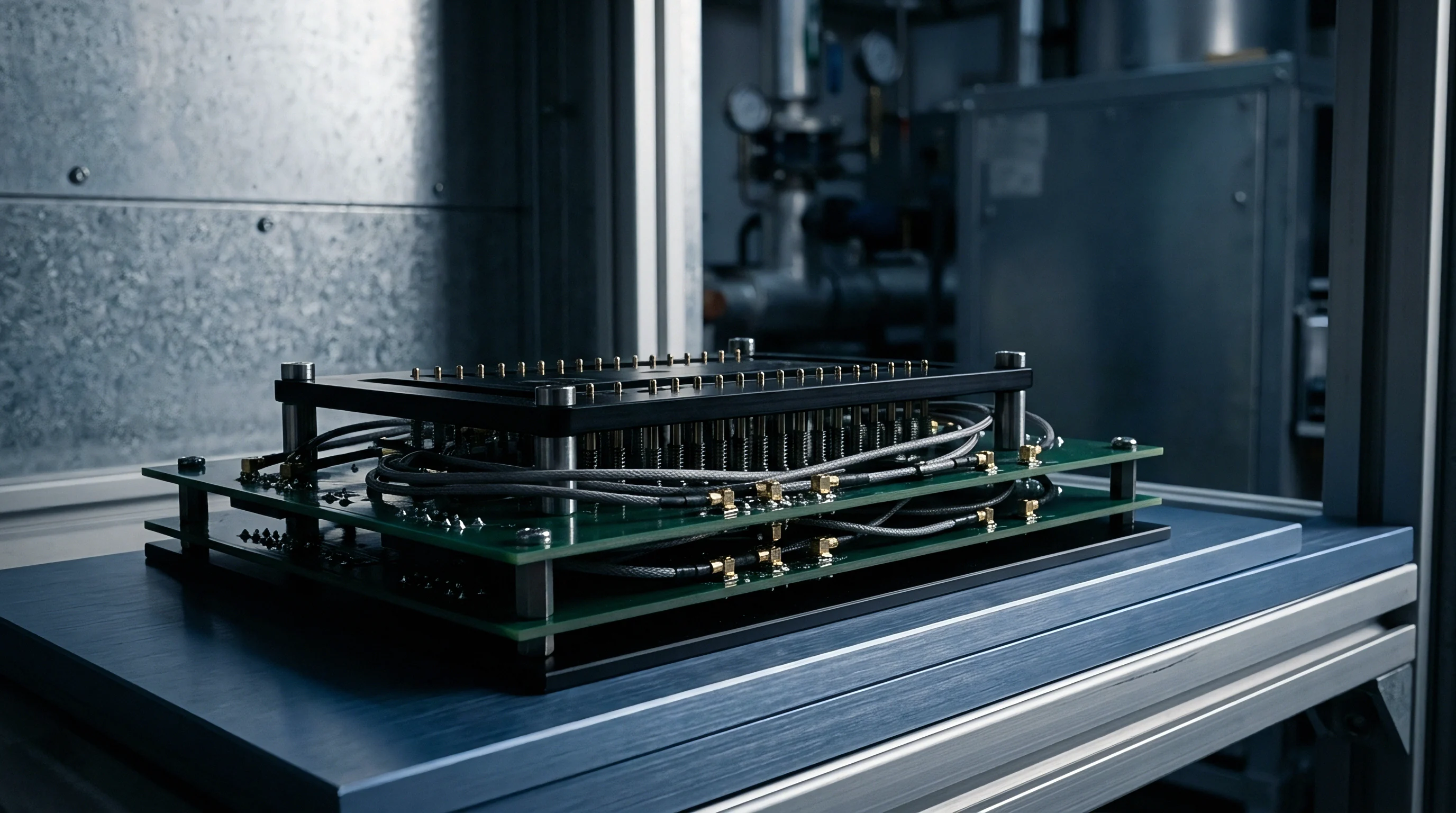
Production test racks on offshore manufacturing lines frequently end up running modified forks of engineering code. At the end of a surface-mount placement line, a functional test fixture connects to programmable power supplies, spectrum analyzers, and bed-of-nails pogo pin interfaces. The intellectual property running those instruments splits across clear boundaries: the module developer owns test sequences, pass-fail thresholds, and radio calibration algorithms, while the contract manufacturer usually supplies the lower-level hardware abstraction layer, driver software, and operator interface routines.
If these assets live inside an untracked zip archive on a factory PC, version control fails almost immediately. Production managers patch scripts locally to get past transient measurement failures or component obsolescence, cutting the link between design verification data and factory floor output.
Commercial agreements for turnkey or semi-custom hardware manufacturing routinely divide engineering ownership into explicit asset schedules. Source code for automated test equipment forms an asset category distinct from device firmware. Because test scripts define the functional envelope of the product, handing uncompiled scripts to an offshore line without cryptographic controls or repository boundaries leads directly to parameter tampering.
When yield numbers drop on third shift, technicians tweak timing delays, widen current-draw tolerances, or skip secondary frequency verification entirely to keep board run-rates up. Maintaining custody requires keeping all fixture source code inside a client-controlled repository, deploying it to factory stations strictly as compiled, signed binaries through an automated pipeline.
The manufacturing services agreement establishes client ownership over all test limits, sequencing scripts, and measurement log schemas regardless of physical fixture location.
Splitting Vendor Infrastructure from Proprietary IP
A clean architectural split keeps proprietary calibration methods separate from vendor line-automation libraries. Contract manufacturers often insist on using internal frameworks developed over years of building fixtures for different clients. Those frameworks handle general factory operations: barcode scanning, pneumatic actuator clamping, safety interlocks, and local database logging.
The product IP itself consists of the specific register writes, radio tuning tables, signal processing routines, and cryptographic key injection steps. Trying to force a vendor to open up their line automation framework usually leads to legal deadlocks over trade secrets. A far cleaner architecture isolates client test logic inside a dynamic-link library or container that communicates with the factory execution system through a documented API.
Isolation preserves buyer portability. If test logic is compiled into the manufacturer’s monolithic environment, qualifying a second-source facility means re-architecting the whole test suite ~ a rewrite that can add four to six months of non-recurring engineering time. Keeping the test engine as an autonomous codebase leaves the manufacturing line framework acting as a simple execution shell that triggers power rails, sends start commands, and receives test payloads.
This separation protects the contract manufacturer’s orchestration secrets while giving the brand owner complete operational control over product verification standards.
Contractual terms dictate how software boundaries operate during line transfers. Standard agreements specify that all fixture code written specifically for the product belongs exclusively to the commissioning client, ensuring that ownership remains clear when production moves.

Depot
Centralized Git Topologies and Submodules
Decentralized factory networks require a single, structured repository topology to keep code bases from drifting across lines. Managing separate repositories for individual factory locations guarantees divergence within three build cycles. A reliable architecture pairs a central test engine repository with hardware-specific abstraction submodules.
The core engine holds the algorithms, state machines, and limit files, while submodules wrap instrument drivers for power meters, signal generators, and digital multimeters used at specific plants. With this setup, Line A in Penang running a four-channel radio communications tester and Line B in Guadalajara using modular signal analyzers execute the exact same functional qualification logic.
Git submodules demand strict commit pinning. Tracking the head of a development branch inside a production deployment repository causes immediate instability: if a developer pushes a revision to a driver submodule, line systems that pull updates on reboot will grab breaking interface changes. Production manifests must pin submodules to immutable semantic tags or specific cryptographic commit hashes.
Local line edits should never happen directly on production branches, and any factory-requested changes must pass through standard feature branches, pull requests, and formal reviews before merging.
Pinning driver submodules to cryptographic commit hashes isolates the factory line from development branch churn.
Replicating repositories across regions often hits network performance barriers. Facilities in mainland China, for instance, frequently suffer severe latency and packet loss when reaching offshore code portals. Localized caching proxies placed inside the manufacturer’s secure perimeter solve synchronization delays while maintaining central authority.
All changes push upstream to the primary client repository before syncing down to factory caches, preserving an unbroken audit trail.
Branching Strategy and Line Provisioning
Managing multiple concurrent manufacturing lines calls for a release-tag strategy rather than environment branches. Branch names tied to physical assembly lines inevitably accumulate quick hacks tailored to a single fixture’s quirks. A clean repository enforces a single main branch with immutable version tags applied to production candidates.
Hotfixes for factory-floor blockers stem directly from the release tag, pass automated testing, and generate a point release deployed across all lines running that manufacturing tier.
| Branch Layer | Access Permissions | Target Platform | Deployment Artifact |
|---|---|---|---|
| main | Read-Only, Architecture Leads | Continuous Integration Server | Source Code |
| release-vX.Y | Protected, Senior Test Engineers | Staging Fixtures | Pre-release Binaries |
| hotfix-vX.Y.Z | Protected, Joint SOW Teams | Validation Benches | Patch Packages |
| production-tags | Immutable, Automation Service | Factory Floor Testers | Cryptographically Signed Binaries |
Engineering teams often ask how to handle local hardware variations without line-specific branching. The answer lies in runtime hardware abstraction files. When a test sequence runs, it queries the station hardware manifest, identifies connected instrument serial numbers, and maps abstract measurement calls to concrete driver routines.
Line-level differences stay isolated in local, signed JSON configuration files checked during hardware discovery, keeping core test logic identical across every plant.
The entire depot architecture fails without granular permission controls. Third-party manufacturing personnel should receive read-only access to compiled release packages, never to source repositories or internal algorithmic documentation. Line technicians may push for raw source access to troubleshoot intermittent serial communication failures on midnight shifts, but compiled packages remain the only safe deployment boundary.

Build
Deterministic Compilation and Containerization
A test sequence compiled on an engineer’s laptop will not behave identically to the same code built on a factory controller. Differences in OS patches, dynamic link libraries, Python micro-versions, and environment paths introduce subtle, non-deterministic measurement noise. Reproducible testing requires deterministic build environments.
Every production artifact ought to come directly from an automated continuous integration pipeline on an isolated build server, removing local developer workstations entirely from the release cycle.
Docker containers and standardized virtual machines provide the execution baseline for modern test stations. Containerizing the environment locks all dependencies ~ including VISA instrumentation runtimes, communication stacks, and math packages ~ to bit-for-bit validated binaries. The production runner image bundles the test executive, configuration files, and compiled algorithms into a read-only container layer.
On boot, the fixture loads this container, mounts an ephemeral scratch disk for local runtime logging, and executes the verification suite against a cryptographically verifiable baseline.
Bare-metal test environments running legacy LabVIEW or native C++ codebases demand rigid package management. Dependency trees are locked using lockfiles that store the exact cryptographic hash of every secondary library. When an instrument driver requires an update, the change updates the manifest, runs through the integration pipeline, passes automated regression testing on golden sample boards, and publishes as a unified installer.
This discipline eliminates a frequent factory issue: two identical test stations yielding divergent parametric distributions because a local engineer installed an untracked driver patch.

Cryptographic Signing and Deployment Packaging
Deploying unsigned executable binaries to remote factory lines leaves the floor vulnerable to silent tampering. Cornered line managers working under tight yield quotas can hex-edit binaries to widen voltage limits or force passing status on failed phases. Protecting product integrity requires digital signatures on every executable, script bundle, and configuration file.
The automated build pipeline signs each release artifact using a private key stored in a hardware security module, distributing only the public key to factory test stations.
- Commit Integration triggers an automated, containerized build on a dedicated server as soon as changes merge into a production release branch.
- Static Analysis scans code for hardcoded secrets, syntax anomalies, and unauthorized tolerance edits against the product requirements database.
- Artifact Compilation compiles raw test logic into platform-specific, obfuscated binaries, stripping debug symbols and proprietary comments.
- Digital Signature signs the compiled bundle with a line-specific key, embedding an immutable SHA-256 manifest of all configuration and driver files.
- Package Encryption encrypts the release payload to protect against reverse-engineering while traversing the manufacturer’s internal network.
- Release Archival stores the verified package in an immutable artifact registry linked directly to the engineering bill of materials revision.
Deploying plain scripts directly to factory lines surrenders configuration control. Facing drifting measurement readings, technicians will edit calibration coefficients directly in text files instead of taking fixtures offline for maintenance. Enforcing signed, compiled deployments prevents local script edits, forcing the plant to fix the underlying hardware ~ whether that means replacing worn probe tips, cleaning sockets, or addressing fixture wear.
This verification chain creates clear legal attribution if uncertified hardware leaves the plant. If defective products bypass testing because of patched software, the validation certificate fails to verify, shifting warranty and recall costs entirely to the assembly vendor under standard manufacturing covenants.
Drift
Mechanisms of Unauthorized Factory Modifications
Factory lines inevitably diverge from the central engineering baseline unless active safeguards prevent local editing. Contract plants operate under relentless pressure around throughput, overall equipment effectiveness, and first-pass yield. When an assembly line sees an unexplained drop in yield, line engineers face immediate demands to fix it.
Because pausing production to wait for an overseas client review wastes valuable capacity, technicians often make undocumented fixes directly on the fixture PC to hit shift targets.
These modifications follow well-known patterns across offshore manufacturing plants:
- Tolerance Widening relaxes pass-fail limits on noisy channels so borderline assemblies do not trigger line stops.
- Delay Truncation cuts settling times and sleep durations in serial calls to trim station cycle times and boost units-per-hour metrics.
- Retry Looping wraps unstable test steps in hidden repeat-until-pass loops, masking solder opens, marginal RF performance, or power rail bounce.
- Limit Hardcoding bypasses external JSON files to inject hardcoded pass values directly into execution functions when instruments drop communications.
- Phase Disabling comments out stress tests, high-current checks, or thermal saturation routines to keep active fixtures running without downtime.
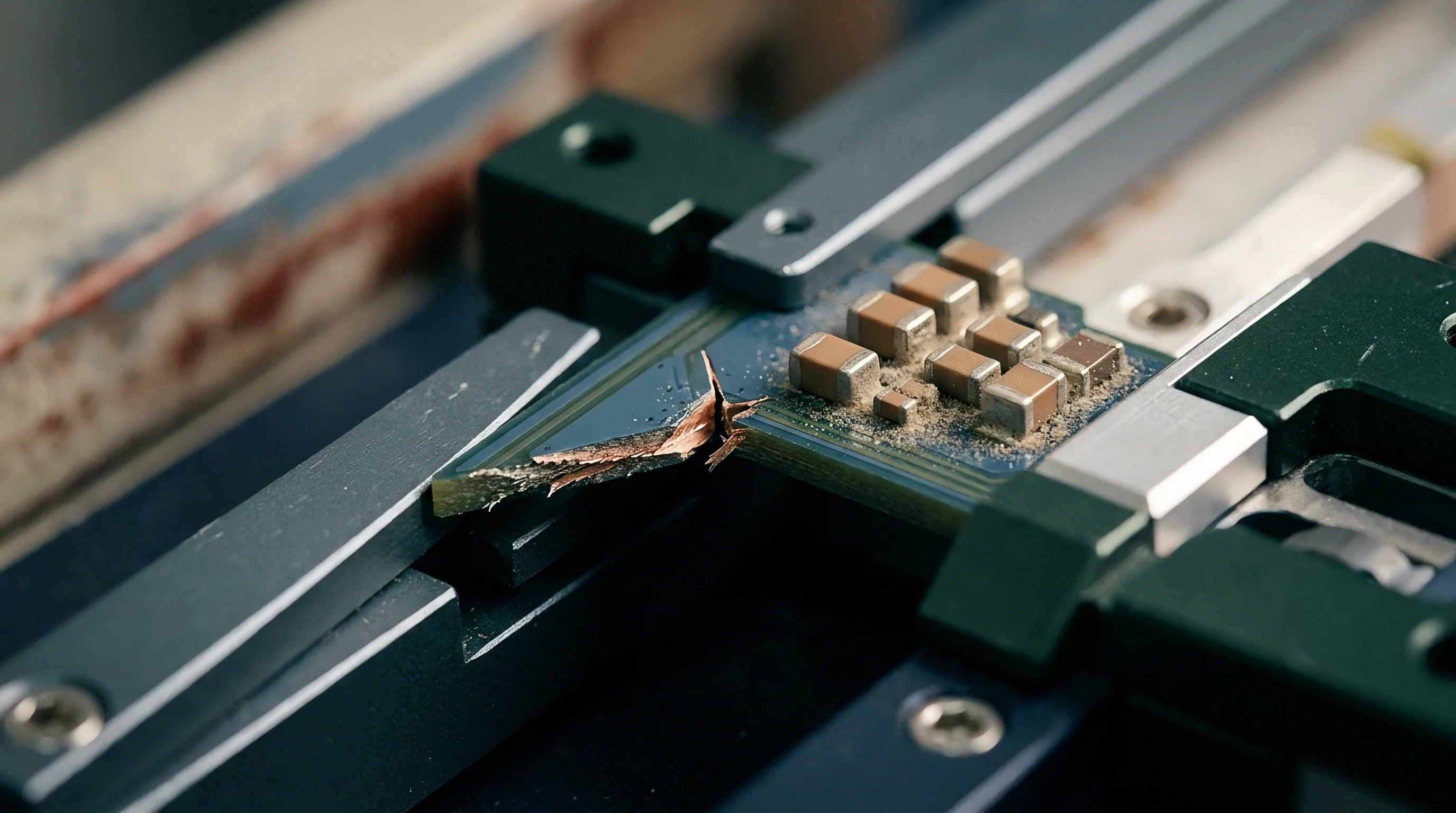
Unplanned changes like these severely undermine field reliability. A board with a cracked clock trace or poorly seated capacitor can easily pass a test routine hidden behind a five-pass retry loop. It ships out as good stock, only to fail in the field when subjected to real-world vibration and thermal stress.
Managing drift requires treating factory test PCs not as trusted machines, but as endpoints that must be continuously audited.
Automated Telemetry and Verification Audits
Maintaining fixture integrity across distant assembly facilities requires continuous hash verification paired with streaming measurement telemetry. Before running a single test cycle, the test executive on the local station must compute a cryptographic hash of its entire execution package, including every dynamic library, limit profile, and script. Combining this hash with a unique station ID and timestamp signs the test record for that unit serial number.
Unsigned test logs lacking runtime executable hashes fail incoming quality audits regardless of yield figures.
Streaming raw measurement data directly to a client-controlled cloud database bypasses local factory servers entirely. Comparing parametric distributions across lines quickly exposes unauthorized changes. If Line 1 in Dongguan shows an unnaturally narrow current-draw distribution with zero marginal failures while Line 2 in Haiphong displays a standard Gaussian curve with a two percent failure rate, Line 1 has almost certainly applied limit overrides or skipped test stages.
| Observed Telemetry Anomaly | Underlying Script Alteration | Operational Risk |
|---|---|---|
| Abrupt cycle time decrease under 10% | Settling delays removed from driver loops | Measurement reading unstable voltage levels |
| Bimodal execution time distribution | Hidden repeat-until-pass conditional loop inserted | Intermittent hardware shipped as passing product |
| Zero failures across critical RF bands | Hardcoded pass parameters substituting real instrument data | Uncalibrated transmitters entering distribution |
| Hash mismatch in execution metadata | Manual modification of local test limits file | Total invalidation of manufacturing traceability |
Telemetry collection has to happen at the unit level. End-of-shift summary spreadsheets provided by factory staff hide anomalies behind statistical smoothing. Real-time, unit-by-unit telemetry provides the mathematical proof needed to stop a line and insist on immediate corrective maintenance.
When telemetry flags an execution hash mismatch, the line halts processing work-in-progress inventory. The client quality team locks the station remotely via the build server, and the vendor absorbs the cost of quarantining every unit processed since the last valid hash was logged.

Bringup
Cross-Facility Qualification and Gauge R and R
Qualifying a new plant or setting up a parallel line requires validating software, fixture mechanics, and instrumentation together. Pushing verified code onto a new fixture rarely produces matching parametric results on day one: mechanical alignment on pogo pins, ground loop impedance, cable capacitance, and instrument calibration drift all create measurement offsets. Sourcing teams separate software bugs from physical variation using a standard Gauge Repeatability and Reproducibility protocol.
A typical qualification run passes thirty golden units of known parametric performance across the new line. Each unit is tested ten consecutive times across different shifts and operators without modifying source code or configuration files. Gauge Repeatability and Reproducibility analysis splits observed measurement variance into equipment and operator factors.
If total fixture measurement variance exceeds ten percent of the tolerance band, line bring-up fails, requiring physical or instrumentation repairs rather than software patches.
Factory engineers often try to calibrate away wiring issues by inserting software offsets into driver code. If an analog-to-digital converter reads twenty millivolts low on Line 2 because an unshielded signal wire runs next to a motor power line, adding a twenty-millivolt software offset simply hides the noise. Under higher ambient temperatures or heavier motor loads, that noise spikes and corrupts real production measurements.
Software teams should strictly forbid local software offsets: the physical fixture must be rewired, shielded, or repaired until its baseline distribution matches specification within physical limits.
Acceptance Frameworks for Second-Source Lines
Qualifying a secondary contract manufacturer introduces both legal and technical complications during code transfer. The second-source facility usually runs different functional testers, alternative power rails, and distinct factory database platforms. Adapting the core software suite to this new environment demands a formal acceptance framework tied to contractual deliverables.
- Hardware Discovery Validation runs an automated self-test script to scan the instrumentation bus, verify equipment serial numbers, query calibration dates, and check interface communication latency.
- Loopback Interface Verification executes a diagnostic test harness connecting output rails to input measurement lines, verifying that pogo pins, multiplexers, and routing relays operate within impedance limits.
- Golden Unit Parametric Run processes thirty pre-tested golden modules through the compiled test suite to confirm that parametric distributions match baseline factory metrics within an Anderson-Darling threshold.
- Boundary Fault Injection tests boards with intentional faults ~ such as dead radios, shorted power rails, or corrupt flash memory ~ to verify that the suite catches and quarantines defects.
- Stress and Cycle Time Run processes five hundred production units at full line speed to ensure the test executive manages high-volume runs without memory leaks, deadlocks, or crashes.
Managing this process requires total clarity on non-recurring engineering fees. Vendor quotes regularly include hundreds of engineering hours to adapt client software to local lines. A modular, containerized test architecture reduces that work strictly to driver integration, preventing vendors from billing to rewrite core verification logic.
Verifying that a second-source factory runs the exact golden test suite without unauthorized code tweaks on un-audited graveyard shifts requires automated runtime validation.
Self-attesting test containers provide this continuous verification. Upon completing each unit cycle, the runtime engine calculates an encrypted attestation token combining station hardware profiles, running container hashes, device serial numbers, and raw test vectors. This token is written directly into non-volatile memory on the device during final provisioning.
Any unit lacking this cryptographically signed certificate fails downstream packing verification, preventing unauthorized test paths from reaching customers.
Covenant
Contractual Retainage and Source Escrow
Commercial contracts define what happens when technical controls fail. Sourcing custom or semi-custom electronics requires embedding source code management, fixture ownership, and deployment rights directly into the Master Manufacturing Services Agreement. Leaving test software as an informal detail hands the manufacturer leverage during pricing disputes or volume transfers.
If a vendor writes test scripts without explicit IP assignment, they legally own that test infrastructure ~ meaning a buyer trying to move production to another plant will find themselves forced to buy back the fixture code at steep rates.
Sourcing agreements should explicitly state that all fixture software, automation scripts, test limits, and abstraction drivers developed for the product are work made for hire, owned exclusively by the client. Non-recurring engineering payments must tie directly to milestone deliverables: full source repositories, uncompiled assets, build scripts, and reproducible container definitions. Withholding twenty to thirty percent of the engineering fee until the complete software package builds deterministically on client servers provides strong leverage for vendor compliance.
Section 8.4 assigns all right, title, and interest in fixture test scripts, limit definitions, and test container manifests exclusively to the buyer upon milestone payment.

The Exit Transfer Package and Line Relocation
Relocating production between plants is the ultimate test of code management. If transferring test software relies on the original factory’s goodwill, the move will stall. A complete, self-contained transfer package ensures that a competent second-source plant can bring up a parallel test station within two weeks of receiving hardware.
A formal test software transfer dossier requires specific, verifiable engineering artifacts:
- Clean Git Repositories stripped of machine-specific paths, hardcoded local IP addresses, and vendor framework dependencies.
- Automated Build Scripts able to compile raw source code into deployment binaries on a bare, air-gapped server.
- Containerization Blueprints specifying the exact Linux or Windows OS image, package versions, dynamic-link libraries, and environment variables.
- Instrumentation Driver Sources built on open standards like VISA to allow equipment swaps without changing core algorithms.
- Self-Test Diagnostic Suites designed to validate fixture hardware, loopback harnesses, and pogo pin continuity independent of production units.
- Verification Golden Datasets containing raw parametric measurements from golden sample boards to calibrate and compare line instances.
Poor software management carries immediate financial costs: an un-reproducible test suite leaves physical fixtures stranded, invalidates manufacturing warranties, and forces weeks of emergency engineering work to reverse-engineer undocumented factory patches.