Dynamic Guard Window Scaling Algorithms for Narrowband Duty-Cycled Sub-GHz Networks under Severe Thermal Swings
Dynamic guard window algorithms prevent link loss under severe thermal swings by adjusting sub-GHz receive windows to crystal thermal lag and temperature derivative rates.
Swell
A current probe clipped to the supply line of an outdoor sub-GHz transceiver reveals the silent energy loss of timing uncertainty. When an industrial wireless sensor wakes up from a 900-second deep sleep cycle, its receiver circuit energizes long before the expected arrival of the downlink preamble. Under a stable laboratory ambient of 20 degrees Celsius, a static guard window of 10 milliseconds reliably captures incoming frames while spending minimal energy.
Place that same node on an exposed pipeline in West Texas, where direct solar radiation drives internal enclosure temperatures from a pre-dawn low of -10 degrees Celsius to an afternoon peak of 65 degrees Celsius at thermal slew rates exceeding 1.5 degrees Celsius per minute, and the static window collapses. The 32.768 kHz tuning-fork crystal driving the low-power sleep clock shifts frequency along its parabolic thermal curve, accumulating tens of PPM in clock drift between synchronization intervals.
Receiver timing errors force network architects into a difficult choice. Expanding static guard windows to absorb worst-case thermal drift keeps nodes connected, yet it consumes the node battery on unneeded receiver listening time. Leaving guard windows narrow saves power under moderate temperatures, but leads to missed preamble captures, packet loss, and catastrophic re-join cascades when ambient temperatures swing rapidly.
Sub-GHz narrow-band systems operating under sub-gigahertz regional band rules cannot afford the power penalty of arbitrary receiver window expansion, nor can they tolerate the latency of high-power TCXO components kept continuously active.
| Clock Source Type | Frequency Tolerance at 25C | Parabolic / Thermal Coefficient | Accumulated Drift Over 900s Sleep (-20C to +60C) | Required Minimum Guard Window Expansion |
|---|---|---|---|---|
| Uncompensated Tuning Fork Crystal (32.768 kHz) | +/- 20 ppm | -0.035 ppm/C^2 | 192.8 ms | 385.6 ms |
| Factory Calibrated Internal RC Oscillator | +/- 500 ppm | +/- 20 ppm/C | 1,800.0 ms | 3,600.0 ms |
| Temperature Compensated Crystal Oscillator (TCXO) | +/- 1.5 ppm | Linear over temp range | 4.05 ms | 8.1 ms |
| On-Chip Digitally Trimmed Crystal Array | +/- 10 ppm | Lookup table compensated | 18.2 ms | 36.4 ms |
Receiver sensitivity in narrow-band sub-GHz deployments relies on tightly matched channel filters and prolonged preamble sequences. A LoRaWAN network operating at SF10 with a 125 kHz bandwidth features a symbol duration of 8.19 milliseconds. If thermal drift shifts the sleep counter phase by three symbol periods during a 15-minute sleep cycle, the receiver misses the sync word entirely.
The node stays awake for the full receive window length, burning 11 milliamperes at 3.3 volts, only to log a timeout. Dynamic guard window scaling algorithms replace fixed temporal margins with adaptive intervals calculated from real-time thermal telemetry, local clock characteristics, and measured historical drift.
An uncompensated 32.768 kHz quartz crystal operating at 60 degrees Celsius incurs 192.8 milliseconds of drift over a fifteen-minute sleep interval, demanding a receiver guard window exceeding 385 milliseconds to prevent frame loss.
Deploying static timing margins across variable outdoor environments results in accelerated battery exhaustion, non-compliance with regional radio spectrum duty-cycle limits, or complete loss of network synchronization during rapid ambient shifts.


Physics
Quartz Thermal Dynamics and Crystal Physics
Quartz crystal resonators utilized in sub-GHz radio designs rely on physical mechanical deformation under piezoelectric excitation. Standard low-power sleep circuits utilize tuning-fork crystals cut along the AT or NC crystal orientation. The physical geometry of a 32.768 kHz tuning fork generates a parabolic frequency deviation relative to temperature, centered on a turn-point temperature typically calibrated near 25 degrees Celsius.
Temperature shifts away from the nominal inflection point induce a predictable drop in oscillation frequency. The mathematical relationship governing uncompensated quartz drift follows a quadratic parabolic curve:
f_error = k (T – T_0)^2 + f_initial
The parabolic parabolic coefficient k for standard 32.768 kHz crystals sits between -0.032 and -0.038 PPM per degree Celsius squared. A temperature offset of 35 degrees Celsius above ambient yields an instantaneous frequency shift of -42.8 PPM. Integrated over a 600-second deep-sleep interval, this frequency error translates directly into 25.7 milliseconds of phase shift between the end-device clock and the network gateway time base.
Thermal Mass Incongruity and Junction Slew Rate
Internal transceiver temperature sensors measure silicon junction temperatures rather than crystal blank temperatures. Under direct sunlight exposure, the plastic enclosure heats rapidly, generating a sharp thermal gradient across the printed circuit board. The thermal mass of the quartz enclosure causes crystal temperature to lag internal die temperature readings by several minutes.
Dynamic scaling logic evaluating die temperature during wake-up underestimates quartz drift when ambient thermal slew rates are high. The crystal temperature trails behind rapid heating events, causing algorithms that rely purely on instantaneous temperature lookup tables to overcompensate during rising thermal steps and undercompensate during cooling phases.
Standard commercial sub-GHz module datasheets quote sleep current draws measured under static room temperature without incorporating the energy overhead of dynamic receiver wake-up scaling required under field conditions.
Component vendors often attribute network synchronization failures in high-slew industrial environments to external board layout parasitic capacitance rather than the dynamic thermal lag inherent in quartz crystal packaging.
Calculus
Dynamic Window Calculation Algorithms
Algorithmic formulation of dynamic receiver guard windows calculates temporal bounds based on thermal history, derivative slew trends, and historical packet arrival timing. The total receiver guard window width T_guard expands or contracts dynamically at each schedule event according to explicit operational parameters:
T_guard = 2 (T_sleep (PPM_nominal + PPM_thermal + PPM_aging) + T_jitter) + T_margin
The term PPM_thermal incorporates both the instantaneous parabolic correction and a dynamic derivative term derived from successive temperature readings:
PPM_thermal = k (T_current – T_ref)^2 + alpha (dT / dt)
The derivative scaling factor alpha adjusts window width to accommodate thermal lag between the silicon die temperature sensor and the physical quartz substrate. When ambient temperature changes rapidly, the derivative term forces an asymmetrical expansion of the opening receiver margin, preserving time-on-air capture probability.
How Does Dynamic Scaling Prevent Window Misalignment?
Dynamic scaling evaluates crystal performance in real time by comparing predicted packet arrival against actual sync-word detection interrupts. When a sub-GHz node receives a frame, the radio timer captures the exact symbol phase offset. The network processor computes the residual clock error and updates an internal recursive filter.
This real-time loop tunes the parabolic coefficient k and compensates for crystal aging without requiring offline bench recalibration.
Static linear expansion models assign fixed time overheads regardless of environment. Dynamic recursive algorithms maintain minimum window sizes when nodes reside in thermally stable underground enclosures, expanding windows only during active thermal transitions.
Consider a practical comparison between static worst-case timing and dynamic predictive scaling in an industrial sub-GHz network. Take a 915 MHz node operating at 50 kbps 2-GFSK with a preamble length of 32 bits, receiving a synchronization beacon every 300 seconds. The radio receiver draws 10.5 milliamperes in active mode.
Ambient temperatures swing from 10 degrees Celsius to 50 degrees Celsius at a rate of 2 degrees Celsius per minute.
Under a static worst-case scaling architecture, the system designer must set the guard window to absorb maximum thermal drift across the entire operational envelope. A temperature offset of 25 degrees Celsius yields a drift of 21.8 PPM, requiring a static guard window of 26.2 milliseconds for every 300-second sleep interval. Across 24 hours (288 sync cycles), total receiver window listening time equals 7.54 seconds, consuming 79.2 millicoulombs of charge per day solely on timing overhead.
Under a dynamic predictive algorithm utilizing derivative thermal tracking, the guard window scales with measured local conditions. During stable night hours (10 degrees Celsius ambient, near-zero slew), calculated clock drift drops to 7.8 PPM, contracting the guard window to 9.3 milliseconds. During rapid daytime heating, the derivative coefficient expands the window to 28.5 milliseconds to absorb quartz thermal lag.
The average window duration across 24 hours evaluates to 12.1 milliseconds. Daily energy consumption for receiver timing overhead drops to 36.5 millicoulombs, delivering a 53.9 percent reduction in clock-maintenance power draw while maintaining link reliability.
Regional radio regulatory standards like ETSI EN 300 220 mandate absolute duty-cycle limits as low as 0.1 percent, forcing narrow-band nodes to minimize unacknowledged transmission re-tries caused by clock timing misalignment.
Clock compensation logic operates most effectively when receiver guard expansion maps directly to physical crystal physics rather than arbitrary linear safety margins.

Bench

Current Traces and Real-World Thermal Chamber Profiling
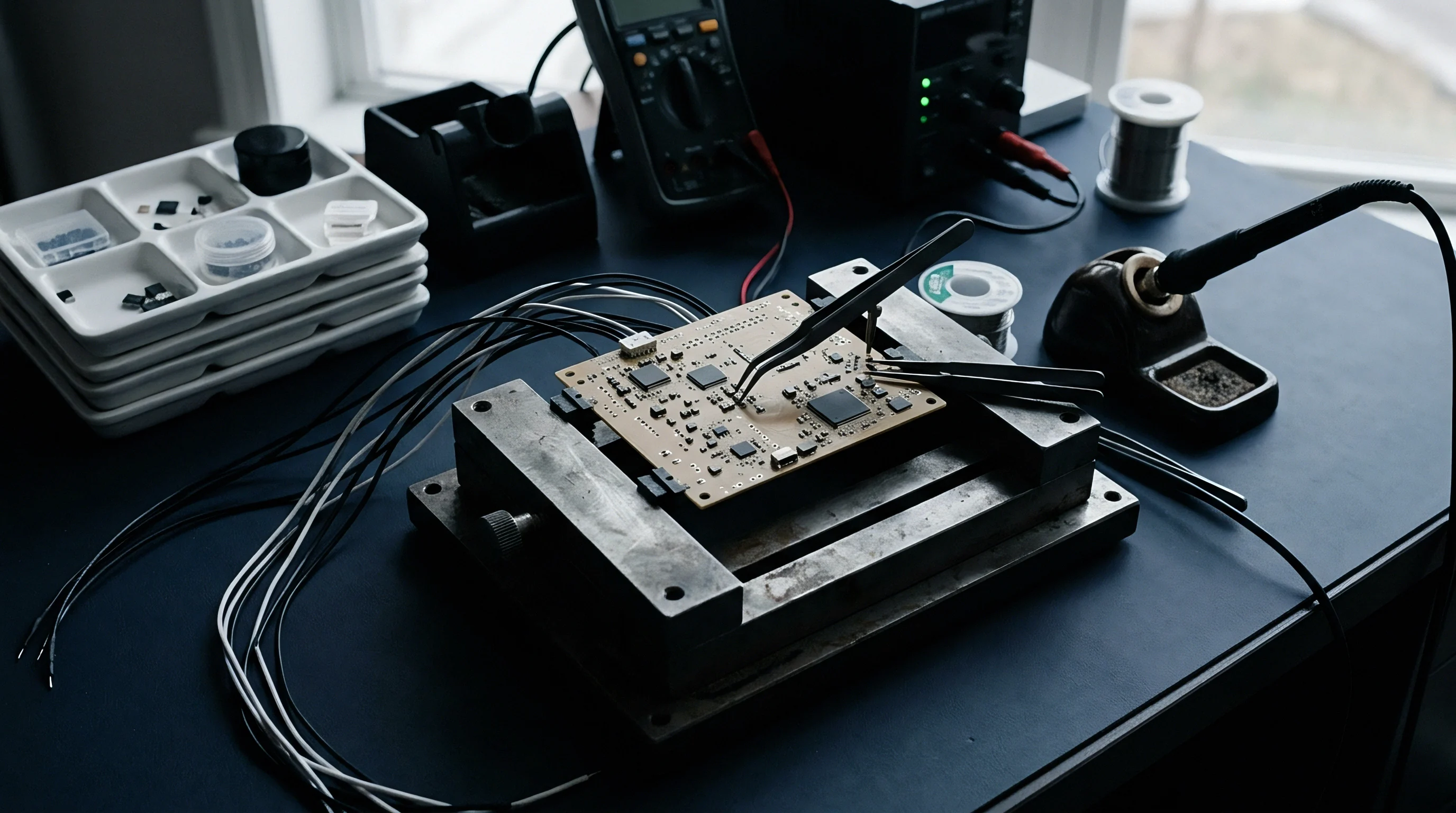
Observing sub-GHz transceiver power pins under test in a thermal environmental chamber clarifies the true cost of clock drift. A low-power profile trace reveals distinct functional phases during each scheduled receive event: crystal oscillator wake-up, phase-locked loop synthesis, dynamic receiver guard window idle listening, preamble detection, payload reception, and processing turnaround.
When crystal compensation is accurate, the preamble arrives cleanly within the first 15 percent of the receiver listen window. The radio locks phase instantly, decodes the header, and returns the MCU to sleep immediately after payload acquisition. When thermal swings distort uncompensated sleep clocks, receiver idle listening extends across the full guard window before packet arrival, multiplying active phase energy consumption by a factor of four.
Profiling crystal performance across temperature ramps requires systematically controlled bench conditions to separate ambient thermal effects from internal chip self-heating.
- Mount the sub-GHz device under test inside a programmable environmental chamber with localized thermal couples attached to both the transceiver die package and the external quartz crystal housing.
- Connect a high-bandwidth current shunt monitor or power profiling instrument in series with the device 3.3-volt power rail, sampling at a minimum rate of 100 kilosamples per second.
- Initialize radio firmware with continuous thermal logging enabled and dynamic guard scaling disabled to establish absolute uncompensated baseline drift curves across -40 to +85 degrees Celsius ramps.
- Execute controlled thermal ramps at 0.5, 1.5, and 3.0 degrees Celsius per minute, recording packet arrival timestamps relative to expected scheduled transmission windows.
- Enable derivative dynamic guard window compensation, upload calibrated parabolic coefficients, and re-run identical thermal ramps to quantify frame acquisition success rates and energy consumption per frame.
Data captured during high-slew cooling phases demonstrates the absolute necessity of derivative thermal terms. Uncompensated nodes lose synchronization completely when cooling rates exceed 2 degrees Celsius per minute, as die temperature sensors report lower temperatures than the thermally lagging quartz crystal, causing receivers to open their listen windows too late.
Correcting dynamic scaling boundaries based on empirical chamber profiling restores complete frame acquisition integrity across the full thermal envelope without forcing blanket window expansion.
Penalty
Duty-Cycle Ceilings and Battery Lifespan Impacts
System designers who misjudge guard window scaling trade node longevity for link safety. Sub-GHz radios operating in unlicensed bands must comply with regional spectrum regulatory limits. ETSI EN 300 220 restricts unlicensed sub-GHz transmissions in Europe to strict duty-cycle ceilings, typically 1.0 percent or 0.1 percent depending on sub-band allocation.
When thermal drift breaks receiver alignment, lost downlink acknowledgments trigger end-device retransmissions. These uplink retries rapidly consume the allowable daily transmission budget, forcing the radio to enter mandatory regulatory backoff states and dropping critical operational telemetry.
Power source degradation further complicates clock performance. Industrial sub-GHz nodes frequently utilize Primary Lithium Thionyl Chloride (LiSOCl2) batteries due to high energy density and wide operational temperature bounds (-55 to +85 degrees Celsius). LiSOCl2 cells build up a passivation layer during prolonged low-current sleep state.
When a dynamic guard algorithm suddenly wakes the receiver to perform an expanded multi-millisecond listen phase, the initial load current step induces severe passivation voltage dip. If battery voltage drops below transceiver minimum operating threshold (typically 1.8 to 2.2 volts), the microcontroller resets, wiping clock synchronization state from volatile RAM and causing permanent network disconnection.
| Scaling Strategy | Average Receiver Guard Window Width | Daily Timing Overhead Energy (15-min sleep) | Thermal Slew Tolerance (-40C to +85C) | Estimated Battery Lifespan (19Ah LiSOCl2) |
|---|---|---|---|---|
| Fixed Nominal Window (Static) | 5.0 ms | 15.1 mC | Low (Fails above 35C offset) | 14.2 Years (Fails in field) |
| Fixed Worst-Case Window (Static) | 45.0 ms | 136.0 mC | High (Absorbs max drift) | 6.1 Years |
| Linear Temp Interpolated (Dynamic) | 18.5 ms | 55.9 mC | Moderate (Fails high slew) | 10.8 Years |
| Predictive Derivative Tracking (Dynamic) | 10.2 ms | 30.8 mC | High (Tracks thermal lag) | 12.6 Years |
Selection of guard window algorithms directly alters landed product warranty obligations and hardware bill of materials costs.
- Static Nominal Sizing works exclusively in indoor, climate-controlled deployments where ambient shifts remain within a +/- 5 degree Celsius window.
- Static Maximum Sizing protects wireless link integrity at the absolute expense of battery operating life, requiring oversized battery packs and increasing field module footprint.
- Linear Temperature Compensation provides effective optimization under slow seasonal outdoor temperature changes, but experiences packet loss during sharp weather fronts or solar shading shifts.
- Predictive Thermal Derivative Scaling maintains optimal link margins and maximum energy efficiency across severe environmental swings, requiring precise production calibration of thermal coefficients.
Sourcing guidelines for outdoor sub-GHz hardware dictate explicit inclusion of quartz thermal parameters and temperature sensor response tolerances within engineering procurement agreements.

Audit
Sourcing Mandates and Firmware Verification Criteria
Engineering teams specifying sub-GHz radio modules or designing discrete transceiver hardware must enforce stringent validation criteria on clock source selection and firmware execution. Relying on generic supplier claims regarding crystal stability routinely introduces latent thermal failures into production field deployments.
Procurement documentation for sub-GHz connectivity modules must explicitly define the low-power sleep crystal specification, demanding individual batch traceable parabolic coefficient k reporting and maximum initial tolerance bounds at 25 degrees Celsius. Module integration guidelines must mandate the inclusion of persistent Non-Volatile Memory (NVM) calibration registers containing factory-measured crystal offsets and thermal sensor calibration trim values.
Firmware audit routines must verify that dynamic guard window expansion logic correctly incorporates derivative slew terms alongside absolute temperature lookup tables. Test suites must subject candidate firmware revisions to automated thermal chamber ramps while monitoring current profiles to ensure guard windows dynamically contract when ambient temperatures stabilize, preventing permanent run-away window expansion states caused by sensor noise.
How do real-world component tolerance spreads across low-cost tuning-fork quartz batches impact long-term network packet delivery statistics when deployed across multi-year thermal cycling regimes?