Automated Factory Fixture Portability and Diagnostic Script Ownership Agreements
Portability requires itemized NRE payment, uncompiled script source code, native CAD and netlist deliverables, and cold-start verification before sign-off.
Anchor
Line items for automated test equipment on an assembly invoice often hide a basic trap: paying to fabricate a functional test station does not automatically convey the right to operate, modify, or relocate the software driving it. A buyer reviewing a forty-five thousand dollar non-recurring engineering line for a multi-up bed-of-nails functional test rack routinely assumes delivery of the chassis brings full operational autonomy. Instead, contract electronics manufacturers treat test scripts, calibration routines, and fixture wiring netlists as proprietary shop-floor know-how, walling them off from delivered design files.
The line separating product configuration from generic manufacturing IP decides whether a test fixture can actually migrate to a second factory. Standard clauses assigning intellectual property in deliverables fail whenever the master services agreement excludes factory software routines developed by the supplier. When production moves, the physical fixture often arrives at the secondary line as inert metal and pogo pins ~ stripped of the diagnostic executables, firmware flashing routines, and sequencer licences required to power it up.
A services agreement defining intellectual property transfers through finished deliverables leaves underlying diagnostic source code in the factory background repository.
This operational split divides manufacturing test into distinct technical layers with mismatched ownership. Moving the hardware requires mechanical CAD assemblies, probe plate drill files, and schematic interconnect diagrams. Software portability is broader and messier: bare-metal compiler targets, script repositories, test limit tables, and instrumentation driver wrappers.
Suppliers lock in these setups by calling proprietary factory-automation dynamic link libraries from Python, LabVIEW, or TestStand sequences. Diagnostic sequence execution engines are often withheld as trade secrets to protect internal line automation investments. The buyer then faces months of re-engineering, duplicate instrumentation bills, and delayed production ramps at the target facility.
Rig
Dual-sourcing or field repair requires a complete physical drawing package. That means three-dimensional mechanical models, NC drill files for the probe plates, pneumatic hardware bills of materials, and wiring schedules that map every pogo pin directly to its instrumentation channel. Drop any one of those items, and the fixture remains tied to the shop that assembled it.

Mechanical Interface Drawings and Tooling Ownership
The statement of work must define fixture tooling packages explicitly, naming native electronic design automation formats alongside neutral exports. Mechanical plates require STEP models and dimensioned two-dimensional manufacturing drawings specifying material grades: ESD-safe G10/FR4 composites, anodized aluminium frames, and polycarbonate pressure lids. Where pneumatic clamps or vacuum hold-downs are used, stroke tolerances, operating pressure ranges, and seal replacement intervals belong in the equipment dossier.
| Subsystem Category | Native CAD Deliverable | Interchange Format | Validation Criterion |
|---|---|---|---|
| Base Fixture Frame | SolidWorks Assembly (.sldasm) | STEP AP242 / DXF 2D | Mounting hole coordinates match standard 19-inch rack specs |
| Probe Interface Plate | IPC-2581 NC Drill File | Gerber X2 / Excellon | Pin true-position tolerance within 0.05 mm across board area |
| Wiring Interconnect | EPLAN Electric P8 Project | PDF Schematic / CSV Netlist | Every net verified against point-to-point continuity table |
| Load and Stimulus Board | Altium Designer (.PrjPcb) | ODB++ / IPC-2581 Rev B | Board stack-up fabrication matched to copper coupon coupons |
| Pneumatic Actuation | Autodesk Inventor (.iam) | STEP AP214 / PDF Assembly | Stroke cycle life certified to 500,000 actuations under dry air |
Probe maintenance is impossible without full access to the pin netlist. Over long production runs, functional test fixtures take substantial mechanical punishment. Receptacles load up with flux residue, and contact springs lose return force after 100,000 insertions.
Pin pointing errors beyond 50 micrometres trigger false opens and gouge printed circuit board traces.

Signal Conditioning and Interconnect Pinouts
Custom conditioning boards inside the fixture cavity introduce another proprietary bottleneck. Fixtures routinely integrate interposer carrier boards carrying multiplexers, low-noise pre-amplifiers, load banks, and radio-frequency calibration loops. Factories frequently label these custom PCBA interfaces as internal shop tooling rather than project assets, withholding the schematics and bare Gerber data.
Without those interposer files, repairing a channel or building a second station requires reverse-engineering board traces from scratch. The documentation package must specify signal attenuation, trace impedance targets, and pin-to-pin crosstalk limits. Radio-frequency test paths operating at 2.4 GHz or 5.8 GHz demand specific insertion-loss budgets across semi-rigid coaxial jumpers and blind-mate SMA interfaces.
Fixtures built without native trace routing archives require complete physical re-engineering during second-source factory transfer.
Contracts must classify every physical assembly inside the enclosure as client-owned tooling paid for under the non-recurring engineering line. That includes backplane wiring, terminal blocks, ribbon harnesses, calibration shorts, and custom connector interfaces. Retaining physical possession of the box while the factory holds the schematics leaves the buyer with an unserviceable asset.
Code
Firmware, test sequences, and calibration scripts create far steeper transfer hurdles than metal and wiring. Contract manufacturers assemble factory test environments across distinct software tiers: lower layers manage instrument communication over VISA, GPIB, USB, and Ethernet, while upper layers control device-specific test limits, sequence order, and serial bus protocols.

Diagnostic Script Layering and Toolchain Isolation
Script routines often draw dispute because they call shared internal utility classes governing barcode polling, MES handshakes, and pneumatic actuation. The test architecture needs a clean separation between product-level test routines and generic factory integration layers via an open application programming interface.
- Host Execution Environments operate test steps using open runtimes such as vanilla Python or standard C compilers rather than supplier-specific locked frameworks.
- Hardware Abstraction Interfaces isolate measurement commands from specific laboratory bench power supplies, digital multimeters, and spectrum analyzers using standard SCPI protocols.
- Product-Specific Diagnostic Routines exercise onboard microcontrollers, measure current consumption in sleep modes, write cryptographic keys to secure elements, and calibrate RF power tables.
- Manufacturing Execution Plugins transmit serialized test results, operator IDs, station identifiers, and parametric test records into enterprise quality databases.
Diagnostic scripts that call compiled binary libraries create an operational dead end. When a factory delivers tests as compiled executables or password-protected virtual instruments, the customer cannot adjust failure limits, tune parametric thresholds, or debug yield drops. The deliverables schedule must mandate plain-text Python scripts, shell scripts, C/C++ source trees, and SQL schema files with complete build manifests and comments.
Firmware Flashing and Silicon Configuration Scripts
Silicon programming routines require exact dependency and environment definitions. In-fixture programming flashes bootloaders, production application images, softdevices, and manufacturing test firmware onto target microcontrollers, relying on specific software development kits, hardware debugger drivers, and vendor utilities.
| Execution Layer | Underlying Technology | Typical Ownership Default | Target Contract Position |
|---|---|---|---|
| Instrument Drivers | IVI-C / LabVIEW VISA / PyVISA | Public / Third-Party Vendor | Open-source or commercial royalty-free redistributable runtime |
| Station Orchestration | NI TestStand / Custom C# Engine | Contract Manufacturer Background IP | Modular runner supporting platform-neutral XML/JSON profiles |
| Unit Diagnostic Sequences | Python 3.x / Embedded C Routines | Contested Engineering Work | Client Work-For-Hire assigned with full source repositories |
| MES Integration Bridges | REST API / MQTT / ODBC Gateway | Factory Proprietary Core | Mock service stubs provided for offline local testing verification |
The engineering scope must secure the entire flashing pipeline: command-line scripts, binary image merge configurations, address offset flags, serial number provisioning algorithms, and secure boot signing tools. If key injection relies on a closed dynamic library, transferring production to another facility requires rebuilding the cryptographic provisioning flow from scratch.
Terms should state that scripts, test routines, and diagnostic sequences constitute client work-for-hire from the moment of payment. Any factory background IP used to interpret or run the test sequences must carry an irrevocable, perpetual, worldwide, royalty-free licence that permits sublicensing to alternative manufacturing facilities for production, maintenance, and modification.
Scripts delivered without host setup instructions are incomplete deliverables. The development runtime must be defined through container configurations or automated shell manifests; code that functions exclusively on one technician’s workstation fails acceptance testing.

Bench
Validating fixture portability requires hands-on verification before final sign-off. Test fixture acceptance too often comes down to running a golden unit on a single afternoon, leaving measurement variance unexamined. Thorough qualification demands statistical proof of instrument repeatability, reproducibility, and physical detachment from line facilities.
Repeatability and Reproducibility Qualification
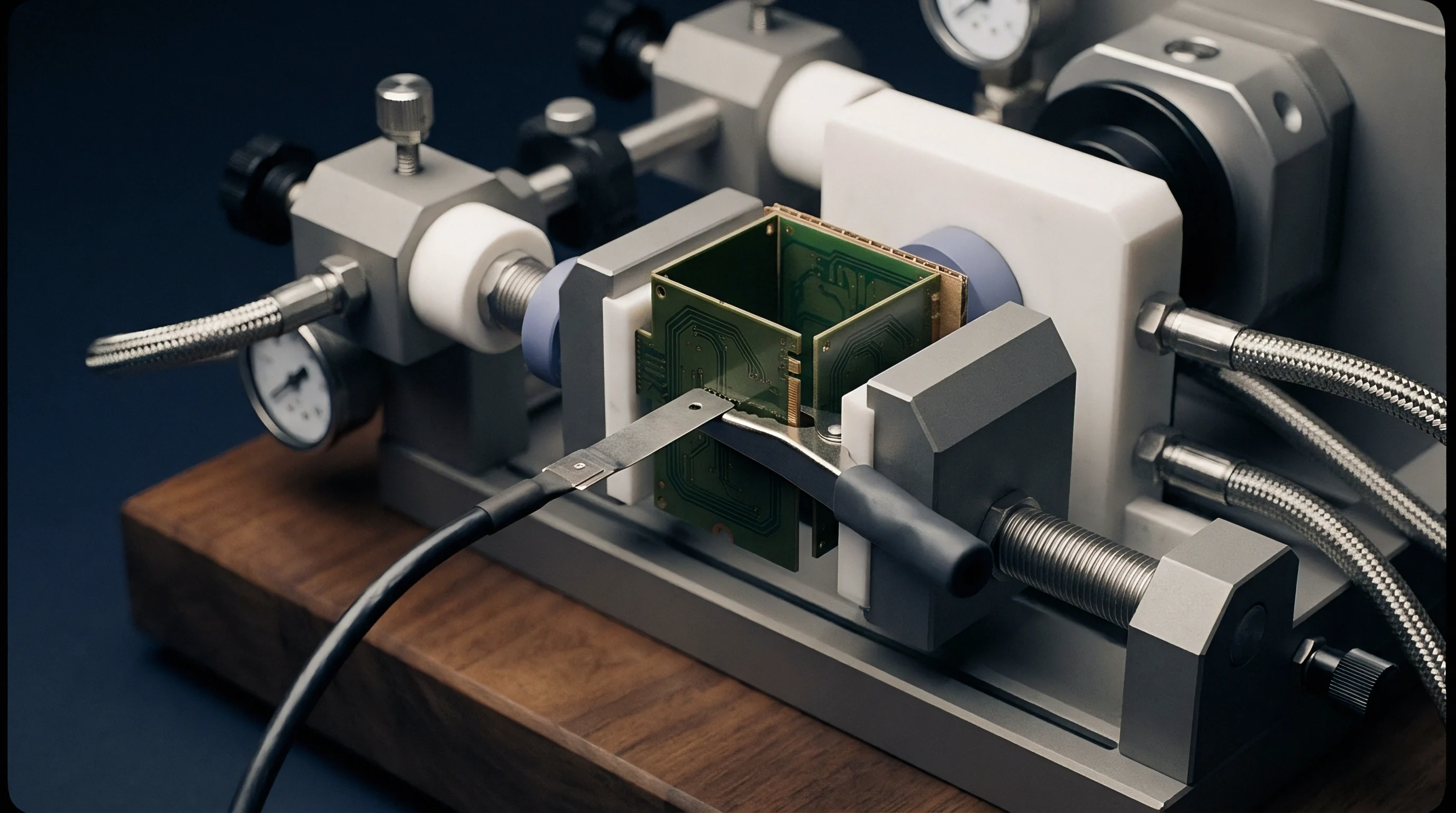
Validating station health requires a formal Gauge Repeatability and Reproducibility study using ten production samples measured across three distinct operator shifts over three consecutive cycles. An automated functional test station must achieve a Precision-to-Tolerance ratio below 10 percent on safety and RF parameters, with a ratio between 10 percent and 30 percent acceptable only on non-critical functional rails.
Calculations follow the analysis of variance methodology. Equipment variance isolates internal electrical noise, mechanical contact stability on pogo pins, and thermal drift inside instrumentation pre-amplifiers; operator variance captures physical alignment differences during manual clamping, barcode scanning pauses, and handling rhythm.
A Gauge R&R test exceeding 30 percent total measurement variation invalidates station sign-off and halts final invoice approval.
The measurement study exposes underlying mechanical flaws. Uneven probe stroke causes variable resistance across power terminals, yielding intermittent voltage sag flags during radio transmissions. If probe plates flex under pneumatic pressure, inner board traces undergo localized strain, causing intermittent contact on small surface-mount test pads.

Are Standalone Cold-Start Criteria Realistically Enforceable?
Acceptance testing procedures should enforce a standalone cold-start test. This protocol requires the test fixture, host controller, instrumentation stack, and diagnostic scripts to be completely disconnected from the factory intranet, local file shares, and live manufacturing execution systems. Technicians move the station to an unnetworked bring-up bench, reconnect line AC power and compressed dry air, and bring up the station using only the installation documentation and cold-start recovery media.
- Operating System Initialization runs entirely from a bare-metal clone image or documented script installation, verifying that no unstated system paths or user environment variables exist on the machine.
- Instrumentation Bus Discovery maps all connected digital multimeters, signal generators, spectrum analyzers, and programmable power supplies using generic VISA addresses rather than static, line-dependent hardware identifiers.
- Mock Service Emulation replaces live shop-floor tracking databases with local loopback responses, confirming that the diagnostic sequencer completes testing cycles without a live network connection.
- Gold-Unit Loop Testing runs five hundred uninterrupted functional cycles on a verified golden sample board, confirming that measurement margins do not drift as the fixture warms up.
- Defect Injection Validation challenges the fixture using ten intentionally faulted units, confirming that out-of-spec frequency drift, shorted rails, and corrupted bootloaders trigger test failures.
If the cold-start verification reveals undocumented system dependencies, missing calibration offset files, or hardcoded server addresses, the station fails acceptance testing. The supplier must correct the software package and documentation at its own expense before receiving non-recurring engineering milestone disbursements. Staging this test before shipping uncovers integration bugs while the vendor engineering team remains commercially engaged.
Clause
Ambiguous tooling ownership inevitably triggers commercial gridlock during production transitions. Sourcing teams frequently utilize master services agreements that treat functional test fixtures as ancillary tooling, failing to draft specific intellectual property, licensing, and documentation transfer clauses. Protective contracting requires precise definitions distinguishing shared baseline utilities from dedicated, client-funded test code.
Defining Transferred Work Product versus Supplier Background IP
Statements of work must clearly designate all functional test deliverables, wiring diagrams, adapter boards, diagnostic scripts, test executive code sequences, and configuration data as customer work product. SOW line items must detail whether the buyer acquires full copyright assignment or merely an operational licence. Without a clear work-for-hire assignment, copyright in diagnostic code resides with the engineering contractor or factory that drafted the algorithms.
Supplier background intellectual property requires strict compartmentalization. Manufacturers rely on standard software engines to run factory lines, and suppliers will not assign complete ownership of proprietary factory sequencers. The contract must balance these interests by granting the client an irrevocable, transferable, worldwide, non-exclusive, fully paid-up licence to run, adapt, and compile all background IP embedded in or required to operate the test station.
Agreements should stipulate that background components must link through standardized, publicly documented interfaces. A supplier cannot fulfill its obligations by providing a compiled binary that binds proprietary background logic directly to product diagnostics without providing source-level decoupling hooks.
Source Code Escrow and Physical Release Covenants
Disputes frequently arise when an electronics manufacturer stops production due to commercial disagreements, insolvency, or capacity realignments. Incorporating test code and fixture design data into a formal escrow arrangement protects the buyer against factory disruption. The escrow agent releases the files upon defined triggering events, including insolvency, failure to maintain production yields, or unilateral production stoppages.
Release conditions must detail both code files and build environment documentation. The repository deposit must include compiler version numbers, dynamic link library dependencies, system configuration settings, and hardware flash tools. Deposits should be updated at every major engineering change order or software release cycle, preventing the escrow account from holding obsolete revisions.
Physical fixture custody terms govern relocation logistics. The master agreement must affirm that physical fixtures, holding tools, and probe assemblies remain client property throughout the engagement. The contract must specify an unimpeded transfer process upon contract termination or production exit, dictating that the manufacturer package, crate, and surrender the fixtures to the client’s freight forwarder within ten business days of written notice, without withholding equipment over disputed operational margins.
A supplier contract negotiation commonly stalls when the factory demands exclusion of all test software from design transfer packages, characterizing diagnostic limits and test timing as confidential process optimization data. Buyers counter this position by offering mutual non-disclosure protections covering manufacturing cycle times while strictly maintaining full ownership of the parametric test limits, defect criteria, and diagnostic flash sequences needed to run external lines.

Ledger
Financial accounting for test development requires unbundling non-recurring engineering line items. A quote presenting test station fabrication as a single lump-sum figure obscures whether the spend funds new software design, hardware tooling, or supplier process overhead. Financial transparency demands an itemized cost ledger tracking hardware bill-of-materials outlays, software development hours, and calibration validation costs.

Non-Recurring Engineering Breakdown and Tooling Amortization
Suppliers sometimes offer to amortize fixture design and non-recurring engineering costs across piece-part production prices. This approach avoids large capital outlays early in product commercialization. However, it complicates ownership disputes, allowing the factory to assert an equity interest in the test equipment because the tooling was not paid for via an upfront, isolated non-recurring engineering transaction.
| Cost Component | Scope Allocation | Typical Cost Band | Commercial Deliverable Milestone |
|---|---|---|---|
| Core Instrumentation | Off-the-shelf laboratory test equipment | $15,000 – $35,000 | Hardware purchase receipts, serials, and calibration certificates |
| Mechanical Fixture Enclosure | Pogo cassette, chassis, actuator, safety interlocks | $8,000 – $14,000 | STEP models, assembly drawings, wiring netlists |
| Signal Conditioning PCB | Interposer layout, fabrication, assembly | $3,500 – $7,000 | Native Altium schematics, Gerber X2 data, full BOM |
| Diagnostic Sequence Dev | Test sequence scripts, pass/fail limit profiles | $12,000 – $25,000 | Complete source repository, commit history, build manifests |
| System Commissioning | Gauge R&R validation, cold-start run | $4,000 – $8,000 | Gauge R&R data report, defect escape verification sign-off |
Direct ownership requires paying for tooling and test equipment through isolated non-recurring engineering purchase orders. Every invoice should itemize the hardware assets, software routines, and validation packages being procured. An unbundled ledger creates a clear paper trail proving that the buyer provided all capital for the design and construction of the station.
Buyers must explicitly establish who pays for duplicate fixtures as production scales. Secondary fixtures fabricated directly from existing design drawings incur significantly lower engineering costs than prototype units. Master agreements should fix the reproduction cost of duplicate test fixtures at the cost of commercial instruments, materials, and direct assembly labor, avoiding repeated design charges.
True Landed Exit Costs and Second-Source Bring-Up
Moving a production line without clean fixture transfer covenants causes substantial financial fallout. Rebuilding an automated functional test fixture from scratch under emergency timelines routinely doubles development costs, requiring expedited shipping, premium fabrication fees, and redundant engineering hours. Production line downtime compounds the financial loss, resulting in factory idling charges, unfulfilled orders, and lost retail placement.
A second-source manufacturing partner requires extensive bring-up documentation to commission an inherited test fixture. The operational handover package must encompass calibrated gold boards, defect injection verification units, spare pogo pins, wire crimp replacement schedules, and step-by-step instrument driver configuration instructions. Neglecting to specify these handover assets during the initial development phase leads to protracted factory downtime during secondary line integration.
A comprehensive functional test agreement balances technical architecture with commercial terms. Sourcing organizations maintain high production continuity and true manufacturing portability by securing complete mechanical CAD files, raw probe netlists, uncompiled diagnostic source scripts, verified cold-start setups, and unbundled non-recurring engineering accounting.
Where core test algorithms are tied directly to factory operating practices, the buyer either funds a clean-room software extraction or absorbs the capital expense of an independent automated test line built outside the supplier’s ecosystem.