
Evaluating Antenna Impedance Matching and Board Layout Strategies for Embedded Transceivers
Evaluating embedded transceiver matching and layout requires conjugate source matching, coplanar ground stitching, and in-housing impedance tuning.
Evaluating embedded transceiver matching and layout requires conjugate source matching, coplanar ground stitching, and in-housing impedance tuning.

RF SOI switch FET stacking ratio and negative substrate biasing set second and third harmonic suppression below mandatory carrier acceptance ceilings across mismatch.

Thermal dielectric drift shifts substrate permittivity and trace impedance, detuning filters and risking band-edge non-compliance during climatic chamber testing.

Semicustom wireless module break-even hinges on offsetting upfront NRE and regulatory fees against unit BOM savings across yield-adjusted volume thresholds.

Laboratory radiated delta scans isolate RF emission changes caused by firmware updates to verify modular approval validity without full re-certification testing.
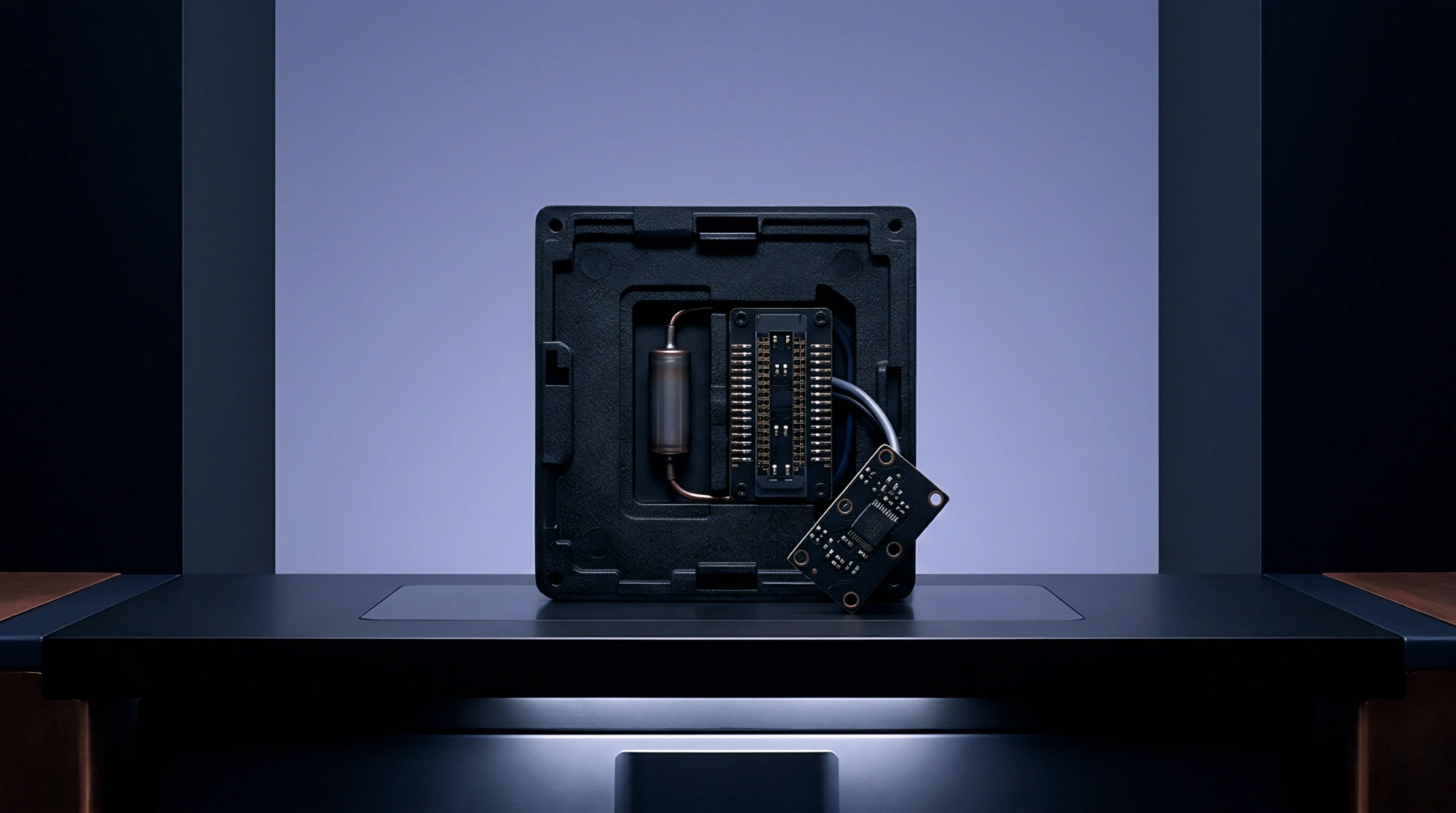
Resolving near field coupling demands tight ground via fencing, solid reference planes, shielded inductors, and continuous enclosure gasket compression.

Host modular radio audits prevent costly market re-certification by verifying trace layout specs, exposure limits, and grant scope before compliance filings.

Trap rich polysilicon layers freeze interface charges to hold high resistivity and suppress switch harmonics below minus eighty dBc.

Second-sourcing a semi-custom module two years post-launch demands complete native CAD source files, uncompiled firmware, and validated factory test jigs.

Conductive polymer composite absorption depends on balancing complex permittivity and skin depth to eliminate surface reflection and satisfy radiated emission limits.
Expertise is a utility, not a secret. sentiention™ publishes its working knowledge as open reference: intelligence layer covering the materials it sources, the markets it enters, and the reference that serves both.