
Chipset End of Life Notices and the Redesign Clock
A silicon end-of-life notice demands an immediate audit of last-time-buy volumes against redesign lead times to prevent production gaps during recertification.
A silicon end-of-life notice demands an immediate audit of last-time-buy volumes against redesign lead times to prevent production gaps during recertification.

Automated RF parameter validation bench testing requires exact S-parameter de-embedding, continuous guardbanding, and rigorous SCPI execution protocols.

Turnkey module scope contracts must explicitly mandate native CAD schematic delivery, environmental verification limits, and test log escrow gates before initial deposits transfer.

Industrial Wi-Fi module selection demands matching OFDM guard intervals to measured hall delay spread while isolating 5 GHz spatial streams from local noise.
Silicon stepping updates demand dynamic register revision checks, thermal corner parametric verification, and permissive change audits before volume cutover.

Dynamic impedance matching mitigates RF power amplifier reflection losses, preserving battery voltage stability and operational lifespan in wideband radios.
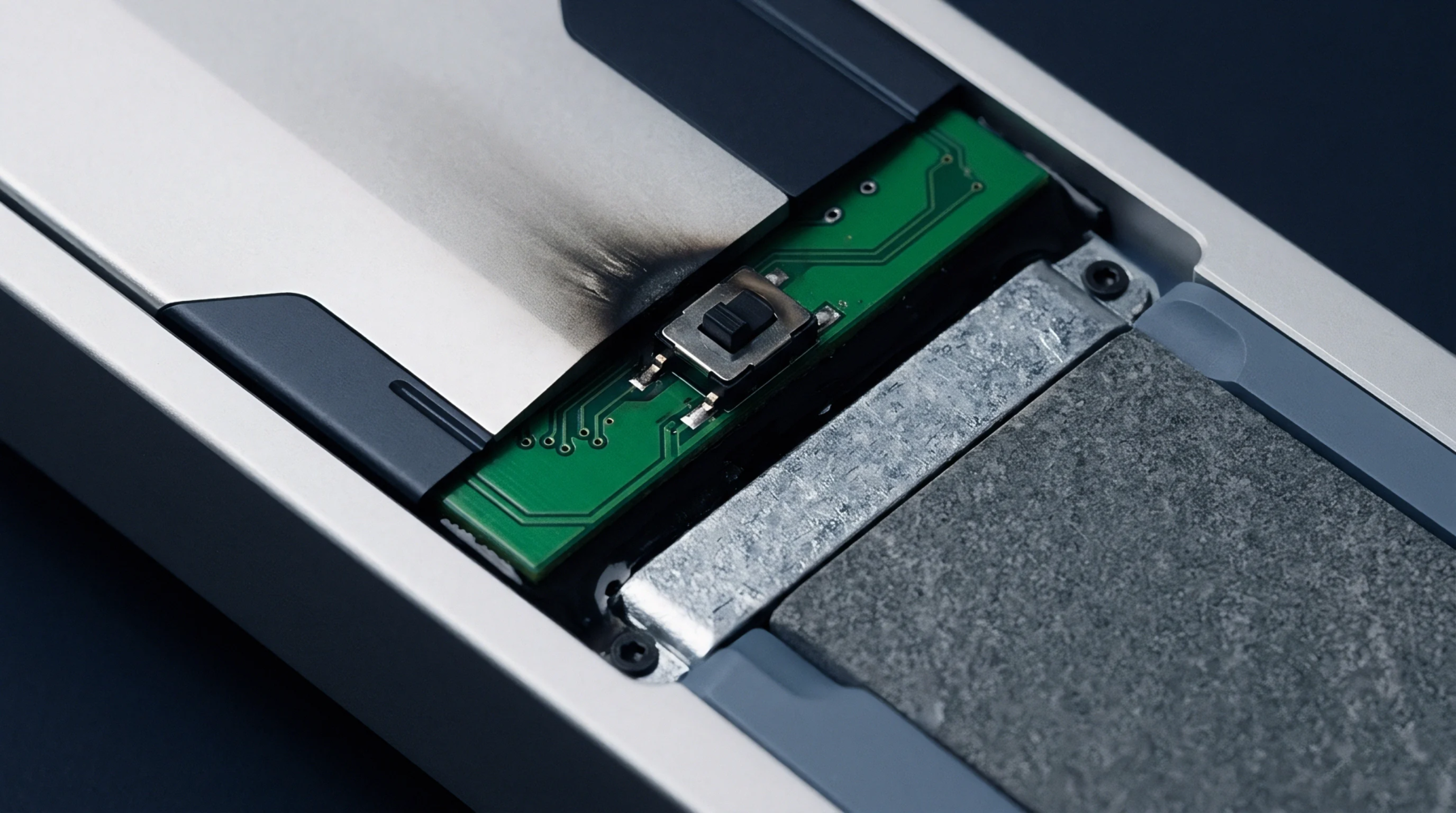
Dynamic impedance matching losses double RF current draw and accelerate battery internal resistance growth, cutting endpoint service life by over fifty percent.

Contractual allocation of RF redesign costs requires an Interface Control Document stackup baseline, binding change orders, and tiered liability thresholds.

Draft engineering test requirements by binding parametric limits to specific fixture loss compensations, statistical sampling schemes, and clear failure remedies.

Parametric contract clauses allocate unannounced silicon revision risks by linking physical RF and current draw deltas directly to invoice price reductions.

Metal layer changes alter integrated transceiver parasitic reactances, corrupting factory calibration matrices and degrading RF performance without recalibration.

Phase noise margin calculations near arc welders demand adding reciprocal mixing degradation figures directly to local oscillator phase noise floors.

Semicustom wireless module break-even hinges on offsetting upfront NRE and regulatory fees against unit BOM savings across yield-adjusted volume thresholds.

Managing multi-vendor RF design transfers requires native IPC-2581 data structures, synchronized change controls, and standardized ATE test files.

High transmit current bursts shift crystal drive levels, causing motional resistance jumps and frequency pulling that degrade wireless packet transmission.

Dynamic impedance matching stabilizes RF power amplifier load lines during battery voltage droop to prevent signal distortion and premature device shutdown.

Aggressive dynamic CCA elevation trades spatial isolation for medium concurrency, raising co-channel interference floors and forcing MCS drops on distant stations.

Antenna detuning shifts transmitter power amplifier load impedance away from nominal conjugate match, slashing power added efficiency and draining battery reserves.

Antenna detuning under high VSWR forces RF power amplifiers into severe voltage rupture or thermal saturation unless verified across multi-band load-pull contours.

Adaptive closed-loop aperture tuning restores detuned cellular antenna efficiency by dynamically switching reactive elements via real-time vector impedance sensing.

Automated software verification isolates physical register and timing deltas across dual-sourced RF boards before volume production begins.

Executing wireless hardware design transfer packages requires native CAD files, reproducible firmware build trees, and calibrated automated RF test fixtures.

Unannounced transceiver silicon stepping changes alter RF match, phase noise, and sleep current, demanding automated register checks and strict PCN terms.

Enforce parametric indemnity clauses tied to dock-level register hash verification and dynamic current benchmarking to prevent silent cellular module failures.
Trap-rich layers eliminate parasitic surface conduction in high-resistivity silicon, suppressing harmonic distortion and insertion loss in RF front-end modules.

Initial contact resistance verification isolates test socket wear to prevent false radio parametric failures and secure accurate module production yields.

Quantify RF test hardware uncertainty budgets under GUM rules and apply inward guardbands to balance consumer risk against false rejection scrap costs.

Dynamic recalibration and memory error correction prevent wireless SoC calibration loss from degrading RF link budgets across extreme operating temperatures.

Fixed milestone payments tie transceiver IP transfers to silicon DRC clean sign-off, bit-accurate testbenches, and calibrated evaluation hardware.

High heat accelerates thermionic emission and trap-assisted tunneling, flipping trim bits that degrade radio receiver sensitivity and break battery budgets.
Expertise is a utility, not a secret. sentiention™ publishes its working knowledge as open reference: intelligence layer covering the materials it sources, the markets it enters, and the reference that serves both.