
Sourcing Ready Modules versus Custom Discrete Circuit Design
Sourcing ready modules minimizes upfront NRE and regulatory risk for mid-volume hardware, while custom discrete designs optimize unit landed cost at scale.
Sourcing ready modules minimizes upfront NRE and regulatory risk for mid-volume hardware, while custom discrete designs optimize unit landed cost at scale.

Cross-border bailment enforcement requires explicit statutory lien waivers, dual-key IP escrow, and pre-agreed replacement cost valuation clauses.

Unbundling hidden engineering hours from unit quotations exposes true manufacturing costs, restores IP ownership, and prevents locked-in margin erosion.

Unapproved silicon stepping changes alter timing, power, and register behavior; enforce 180-day PCN SLAs, automated parametric screens, and strict contract indemnities.

Factory unit quotes bury design, test jig, and maintenance hours in piece prices, requiring unbundled SOW line items to isolate engineering labor and IP rights.

Schematic netlists define logical connections, but copying vendor reference designs without matching physical PCB substrate stackup and trace geometries destroys RF performance and causes immediate electromagnetic compliance failures.

Module IP ownership requires explicit transfer of native CAD files, uncompiled firmware toolchains, and test jigs to break supplier lock in.

Unbundling non-recurring engineering hours in unit quotes isolates amortized costs, establishes clear work boundaries, and protects firmware ownership.
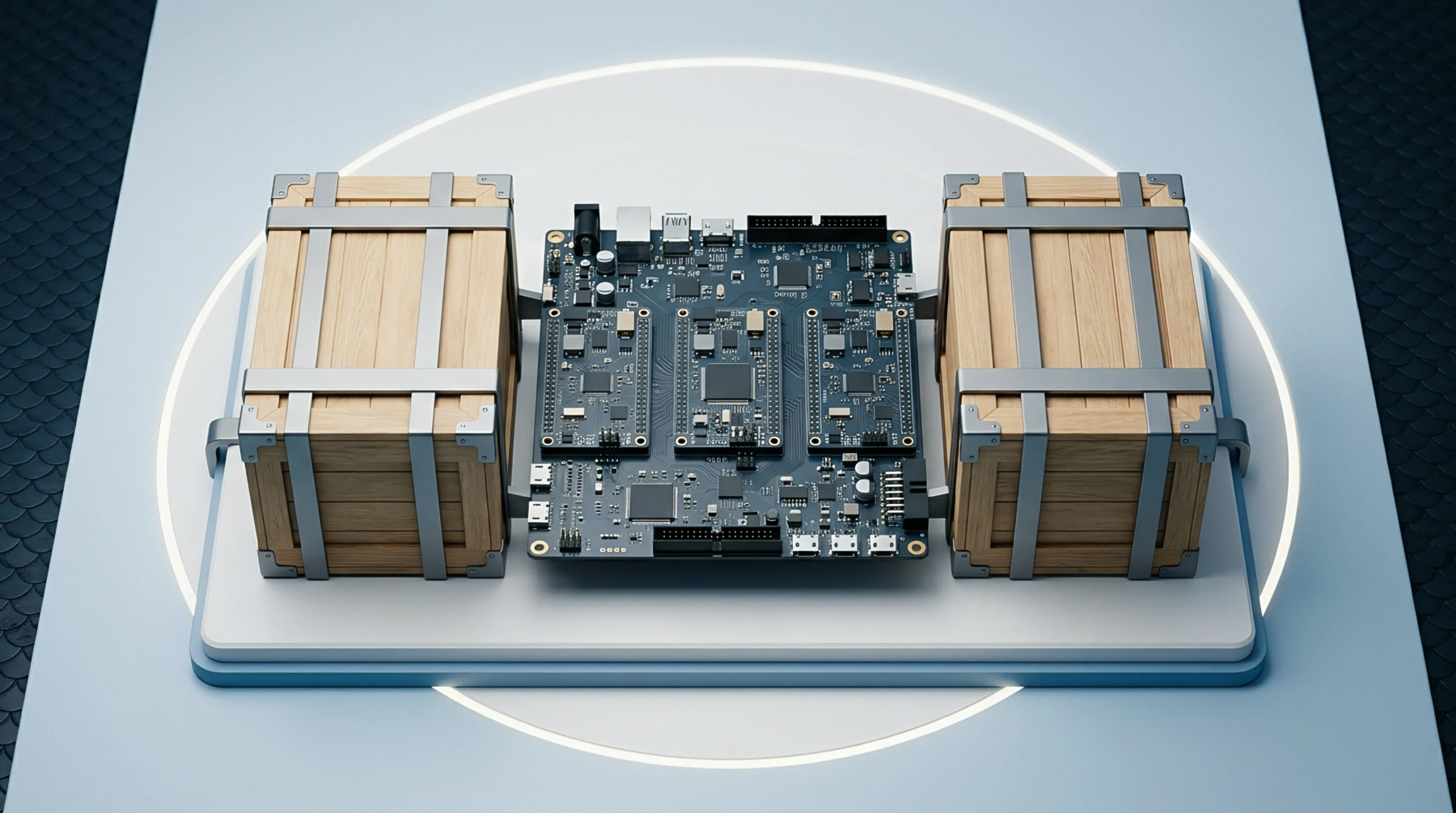
Unbundling NRE from unit pricing via explicit amortization schedules establishes clear buyout terms and secures total ownership of manufacturing design assets.

Kinematic flexure interfaces isolate dissimilar metal thermal expansion mismatch by matching degree-of-freedom constraints to prevent micro-yield and hysteresis.

Auditing transfer packages demands verifying native CAD files, bit-for-bit firmware build parity, ATE jig calibration logs, and ECN histories before tooling.
Deterministic register verification requires post-reset bitwise snapshotting, shadow register diffing, and strict bit-masking HAL drivers across multi-site handovers.

Value design transfer packages by auditing native CAD and firmware source completeness against secondary bring-up friction and NPV returns.

Ground allocation distributes warranty liability across hardware tiers based on integration depth, physical root cause, and explicit contract caps.

Schematic handovers before NRE release require full native CAD project files, netlists, and manufacturing data verified on the bench prior to invoice authorization.

Quantifying shear rates and gate geometry limits prevents fiber length attrition, tool surface erosion, and mechanical strength loss in molded composite parts.
Unbundling engineering deliverables separates physical component supply from native design files, firmware repositories, and test fixtures, ensuring dual-sourcing rights and transparent landed costs.

Decoupling engineering scope from bill of materials costs requires upfront NRE milestone gates, open-book component auditing, and native file handovers.

A complete wireless design transfer requires native CAD databases, test fixture software, and clear grant ownership to prevent dual-source failure.

Lock bills of materials contractually and require automated feeder verification to eliminate unannounced component substitutions in turnkey electronics sourcing.

Minimizing loop inductance in fine-pitch layouts requires microvia-in-pad placement, thin dielectric cores under 50 µm, and tight power-ground via coupling.

Dynamic sensor phase alignment drift stems from combined optical path flexure and clock latency during high-speed trajectories, demanding hardware-level synchronization.

Effective module sourcing requires explicit contractual boundaries defining design dossier ownership, firmware source access, and clear NRE amortization terms.

Metal layer changes alter integrated transceiver parasitic reactances, corrupting factory calibration matrices and degrading RF performance without recalibration.

Verify multi-core shared peripheral register isolation using hardware-in-the-loop stress testing under concurrent bus access and voltage variation conditions

Pinned toolchain containers eliminate host environment drift, delivering bit-for-bit binary reproducible firmware builds for secondary contract manufacturing transfers.
Standardizing hermetic compiler containers and prefix mapping flags resolves binary non-determinism during secondary factory firmware bring-up qualification.

Auditing physical asset wear and unfulfilled engineering deliverables offsets unamortized NRE claims during second-source semi-custom module transitions.
Decoupling HAL code requires isolating vendor driver calls behind abstract C interfaces, securing raw source files, and contracting explicit API acceptance tests.

Validating PCB manufacturing files for wireless modules demands automated netlist audits, explicit impedance stackup definitions, and aperture rule checks.
Expertise is a utility, not a secret. sentiention™ publishes its working knowledge as open reference: intelligence layer covering the materials it sources, the markets it enters, and the reference that serves both.